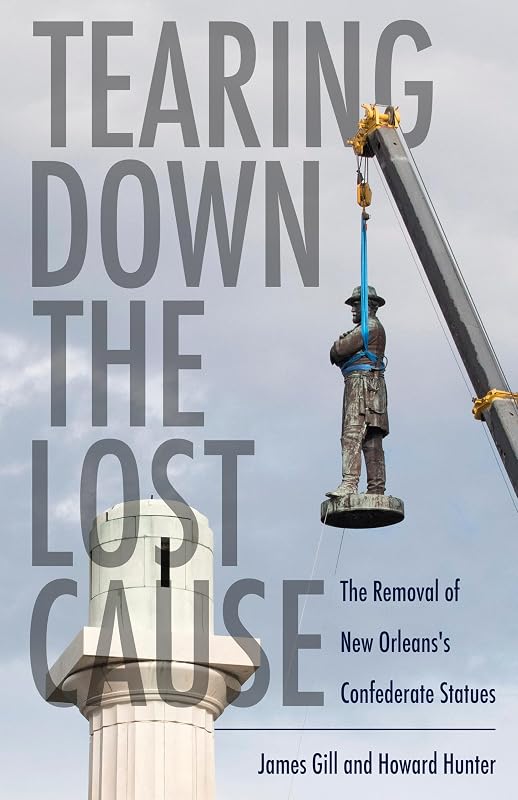
Tearing Down the Lost Cause: The Removal of New Orleans's Confederate Statues by James Gill

Tearing Down the Lost Cause: The Removal of New Orleans's Confederate Statues

James Gill
248 pages
University Press of Mississippi
May 2021
Hardcover
History WSBN
0
Readers
0
Reviews
0
Discussions
0
Quotes
In Tearing Down the Lost Cause: The Removal of New Orleans's Confederate Statues James Gill and Howard Hunter examine New Orleans's complicated relationship with the history of the Confederacy pre- and post-Civil War. The authors open and close their manuscript with the dramatic removal of the city's Confederate statues.. On the eve of the Civil War, New Orleans was far more cosmopolitan than Southern, with its sizable population of immigrants, Northern-born businessmen, and white and Black Creoles. Ambivalent about secession and war, the city bore divided loyalties between the Confederacy and the Union. However, by 1880 New Orleans rivaled Richmond as a bastion of the Lost Cause. After Appomattox, a significant number of Confederate veterans moved into the city giving elites the backing to form a Confederate civic culture.. While it's fair to say that the three Confederate monuments and the white supremacist Liberty Monument all came out of this dangerous nostalgia, the authors argue that each monument embodies its own story and mirrors the city and the times. The Lee monument expressed the bereavement of veterans and a desire to reconcile with the North, though strictly on their own terms. The Davis monument articulated the will of the Ladies Confederate Memorial Association to solidify the Lost Cause and Southern patriotism. The Beauregard Monument honored a local hero, but also symbolized the waning of French New Orleans and rising Americanization. The Liberty Monument, throughout its history, represented white supremacy and the cruel hypocrisy of celebrating a past that never existed.. While the book is a narrative of the rise and fall of the four monuments, it is also about a city engaging history. Gill and Hunter contextualize these statues rather than polarize, interviewing people who are on both sides including citizens, academics, public intellectuals, and former mayor Mitch Landrieu. Using the statues as a lens, the authors construct a compelling narrative that provides a larger cultural history of the city.
Join the conversation

No discussions yet. Join BookLovers to start a discussion about this book!

No reviews yet. Join BookLovers to write the first review!

No quotes shared yet. Join BookLovers to share your favorite quotes!

Earn Points
Your voice matters. Every comment, review, and quote earns you reward points redeemable for Bitcoin.
Comment +5 pts Review +20 pts Quote +7 pts Upvote +1 pt
BookMatch Quiz
Find books similar to this one
About this book
Pages 248
Publisher University Press of...
Published 2021
Readers 0