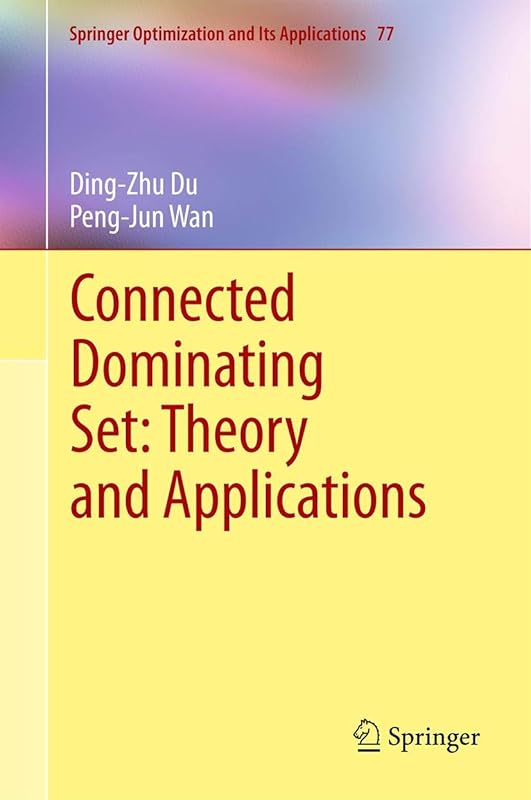
Connected Dominating Set: Theory and Applications (Springer Optimization and Its Applications Book 77) by Ding-Zhu Du

Connected Dominating Set: Theory and Applications (Springer Optimization and Its Applications Book 77)

Ding-Zhu Du
216 pages
Springer
Oct 2012
Hardcover
Science WSBN
0
Readers
0
Reviews
0
Discussions
0
Quotes
The connected dominating set has been a classic subject studied in graph theory since 1975. Since the 1990s, it has been found to have important applications in communication networks, especially in wireless networks, as a virtual backbone. Motivated from those applications, many papers have been published in the literature during last 15 years. Now, the connected dominating set has become a hot research topic in computer science. In this book, we are going to collect recent developments on the connected dominating set, which presents the state of the art in the study of connected dominating sets. The book consists of 16 chapters. Except the 1st one, each chapter is devoted to one problem, and consists of three parts, motivation and overview, problem complexity analysis, and approximation algorithm designs, which will lead the reader to see clearly about the background, formulation, existing important research results, and open problems. Therefore, this would be a very valuable reference book for researchers in computer science and operations research, especially in areas of theoretical computer science, computer communication networks, combinatorial optimization, and discrete mathematics.
Join the conversation

No discussions yet. Join BookLovers to start a discussion about this book!

No reviews yet. Join BookLovers to write the first review!

No quotes shared yet. Join BookLovers to share your favorite quotes!

Earn Points
Your voice matters. Every comment, review, and quote earns you reward points redeemable for Bitcoin.
Comment +5 pts Review +20 pts Quote +7 pts Upvote +1 pt
BookMatch Quiz
Find books similar to this one
About this book
Pages 216
Publisher Springer
Published 2012
Readers 0