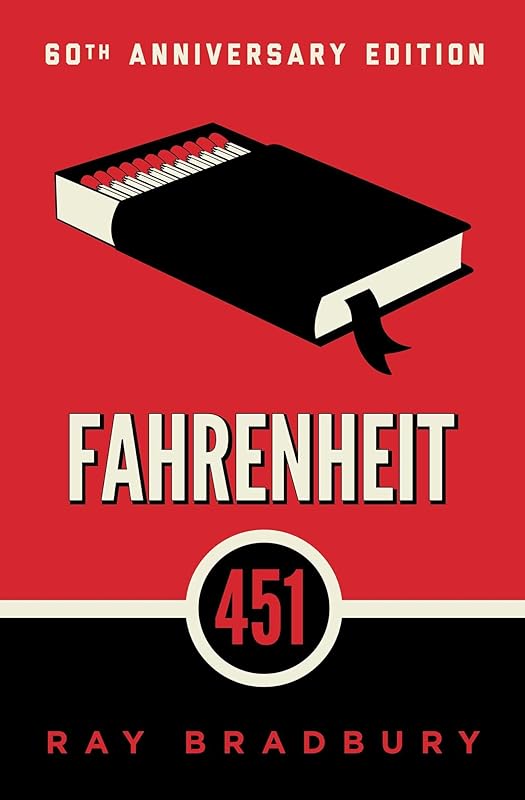
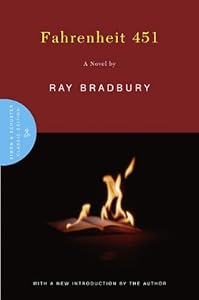
Fahrenheit 451 by Ray Bradbury

Fahrenheit 451

Ray Bradbury
249 pages
Simon & Schuster; Reissue edition
Jan 2012
Paperback
Politics WSBN
7
Readers
1
Reviews
1
Discussions
1
Quotes
Nearly seventy years after its original publication, Ray Bradbury’s internationally acclaimed novel Fahrenheit 451 stands as a classic of world literature set in a bleak, dystopian future. Today its message has grown more relevant than ever before.Guy Montag is a fireman. His job is to destroy the most illegal of commodities, the printed book, along with the houses in which they are hidden. Montag never questions the destruction and ruin his actions produce, returning each day to his bland life and wife, Mildred, who spends all day with her television “family.” But when he meets an eccentric young neighbor, Clarisse, who introduces him to a past where people didn’t live in fear and to a present where one sees the world through the ideas in books instead of the mindless chatter of television, Montag begins to question everything he has ever known.
Dystopian ScienceFiction
Lennart Lopin
Lennart Lopin
10 years ago

one of the great classics everyone needs to read

Review from Contrary World blog (the premier source for all things dystopian)

Fahrenheit 451 is one of my all time favorites. It's written in the third person, placing you into the shoes of an objective narrator who has special access to the thoughts and world view of the characters within the book, especially that of the protagonist. The protagonist (Guy Montag) actually begins the story as a sort of villain really. His profession is that of a future based fireman, who don’t really put out fires like they used to. In fact, they professionally start fires. What a clever twist on Bradbury’s part. These firemen are sanctioned by what one can only conclude to be a dystopian government to burn books, as well as the houses they are contained within. In this future world, the government has deemed books as dangerous, containing ideas that run counter to the narrative they wish to form and broadcast via televisions that cover entire walls within people’s homes. And the people want this, as they feel more comfortable with their government fed information. How dystopian indeed. Reminds one of the behavior of the Roman Catholic Church during the Dark Ages. The two have book burning in common, as well as burning Bibles (in the case of the RCC, Bibles that didn’t subscribe to their criteria – even though they came from source material originating from the same authors). No offense to Catholics – some Protestant sects weren’t much better (like the early Anglicans who destroyed much of the Church’s property, including relics, as did Orthodox Christians during the Iconoclast Era). Montag takes quite apparent joy in his job, causing a smile to overcome his face every time he gets to burn those devilish books. That is, until he becomes intrigued by a young neighbor girl named Clarisse. Clarisse is a female character that many feminists sadly overlook as to her importance in the overall arc of the story. Good on Bradbury for taking this approach, as you know what they say – “behind every great man, there’s an even greater woman”. This doesn’t always have to...

Stuff your eyes with wonder, he said, live as if you'd drop dead in ten seconds. See the world. It's more fantastic than any dream made or paid for in factories.