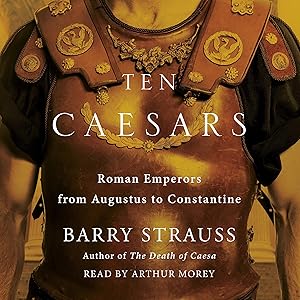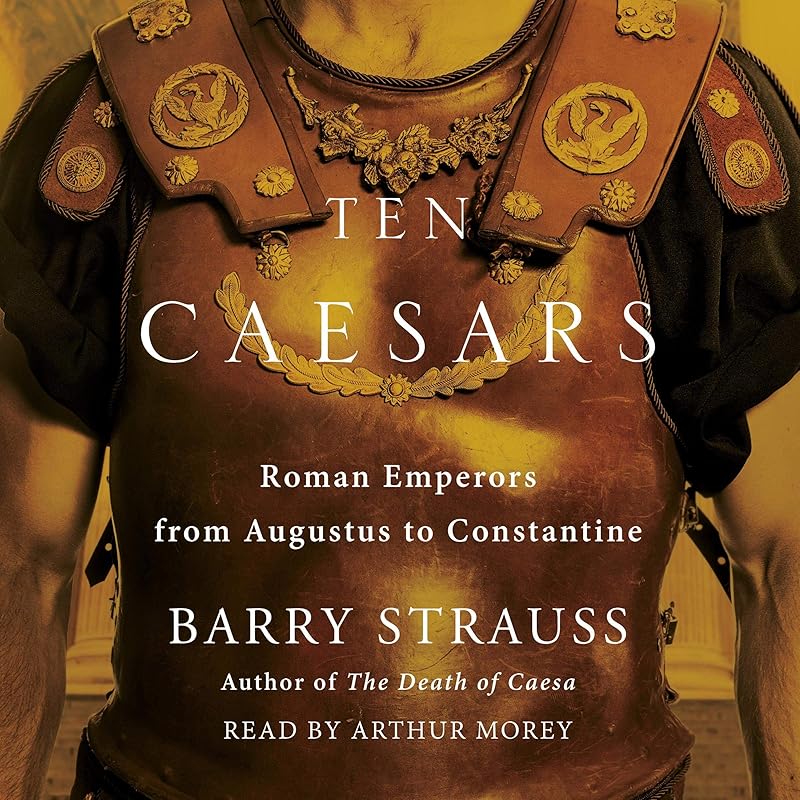
Ten Caesars: Roman Emperors from Augustus to Constantine by Barry Strauss
Ten Caesars: Roman Emperors from Augustus to Constantine

Barry Strauss
Simon & Schuster Audio
Mar 2019
Hardcover
History WSBN
3
Readers
1
Reviews
0
Discussions
4
Quotes
Best-selling classical historian Barry Strauss tells the story of three-and-a-half centuries of the Roman Empire through the lives of 10 of the most important emperors, from Augustus to Constantine.Barry Strauss' Ten Caesars is the story of the Roman Empire from rise to reinvention, from Augustus, who founded the empire, to Constantine, who made it Christian and moved the capital east to Constantinople.During these centuries, Rome gained in splendor and territory, then lost both. The empire reached from modern-day Britain to Iraq, and gradually, emperors came not from the old families of the first century but from men born in the provinces, some of whom had never even seen Rome. By the fourth century, the time of Constantine, the Roman Empire had changed so dramatically in geography, ethnicity, religion, and culture that it would have been virtually unrecognizable to Augustus.In the imperial era, Roman women - mothers, wives, mistresses - had substantial influence over the emperors, and Strauss also profiles the most important among them, from Livia, Augustus' wife, to Helena, Constantine's mother. But even women in the imperial family faced limits, and the emperors often forced them to marry or divorce for purely political reasons.Rome's legacy remains today in so many ways, from language, law, and architecture to the seat of the Roman Catholic Church. Strauss examines this enduring heritage through the lives of the men who shaped it: Augustus, Tiberius, Nero, Vespasian, Trajan, Hadrian, Marcus Aurelius, Septimius Severus, Diocletian, and Constantine. Over the ages, they learned to maintain the family business - the government of an empire - by adapting when necessary and always persevering no matter the cost. Ten Caesars is essential history as well as fascinating biography.
Join the conversation

No discussions yet. Join BookLovers to start a discussion about this book!

What Happens When a Nation Loses Its Republic?

SUMMARY. This book is deceptively short but information-rich. Author Strauss masterfully chooses ten Caesars whose reigns can serve as “jump points” to span this high period of the Western Roman Empire. The book was well-researched yet interesting and easy to understand. Strauss appears to have visited numerous Roman sites, and comments first-hand on their features. By using these prominent Caesars as focal points, Strauss teaches Roman history and introduces the reader to Roman times. Strauss personifies the Caesars by describing them physically from their Roman coinage and surviving statuary, and by speculating about their personalities. He also delves into family relationships and their effect on ruling and succession. The author provides two excellent guides to understand the dynastic framework: a “cast of characters” and a “family tree” for each dynasty. Unfortunately, this material is in the back of the book and not readily discovered. This book reminded me that some of the Roman traditions contributed to the modern world, such as a republican government, a system of laws, and the proclamation of Sunday as a day of rest. But their times also echo current political issues. INTRODUCTION. This book covers a relatively short but important period of Roman rule. From the founding of Rome until the fall of the Eastern Roman Empire covered 2,206 years. The era of the Western Roman emperors covered 520 of those years. And, this book covers 368 years of that period. The book provides a relevant study of what governance was like after Rome lost its republic. Rome formed a republic in 509 BC. But in 44 BC, Julius Caesar became “dictator for life” ending the republic’s 465-year span. From that time until its demise, Rome existed under authoritarian rule. HISTORICAL FRAMEWORK. The initial Caesar in this book, Augustus, was Rome’s first emperor following Julius Caesar. Ruling for 41 years (27 BC-14 AD), Augustus was perhaps the prototype Caesar. The empire’s expansion rea...

“Octavian’s patron, Apollo, the god of reason, had defeated Antony’s patron, Hercules, the symbol of might.”
Page 3
“Octavian’s patron, Apollo, the god of reason, had defeated Antony’s patron, Hercules, the symbol of might.”
Page 3
Among the tens of thousands of prisoners taken by Vespasian in Galilee was the rebel-appointed Jewish governor of the province, Joseph ben Matthias. He was destined to be brought to Rome and executed, but he found a way out. He prophesied to Vespasian that he would be emperor. When in turn the legions indeed proclaimed Vespasian emperor, Joseph was freed from his chains. Although some Romans considered Joseph a Jewish spy, Vespasian and Titus found him useful. After the war, he ended up in Rome living in the palace under their protection, became a Roman citizen named Flavius Josephus, and wrote a detailed history of the revolt that survives today.
mong the tens of thousands of prisoners taken by Vespasian in Galilee was the rebel-appointed Jewish governor of the province, Joseph ben Matthias. He was destined to be brought to Rome and executed, but he found a way out. He prophesied to Vespasian that he would be emperor. When in turn the legions indeed proclaimed Vespasian emperor, Joseph was freed from his chains. Although some Romans considered Joseph a Jewish spy, Vespasian and Titus found him useful. After the war, he ended up in Rome living in the palace under their protection, became a Roman citizen named Flavius Josephus, and wrote a detailed history of the revolt that survives today.
Page 143
Earn Points
Your voice matters. Every comment, review, and quote earns you reward points redeemable for Bitcoin.
Comment +5 pts Review +20 pts Quote +7 pts Upvote +1 pt
BookMatch Quiz
Find books similar to this one
About this book
Publisher Simon & Schuster Aud...
Published 2019
Readers 3