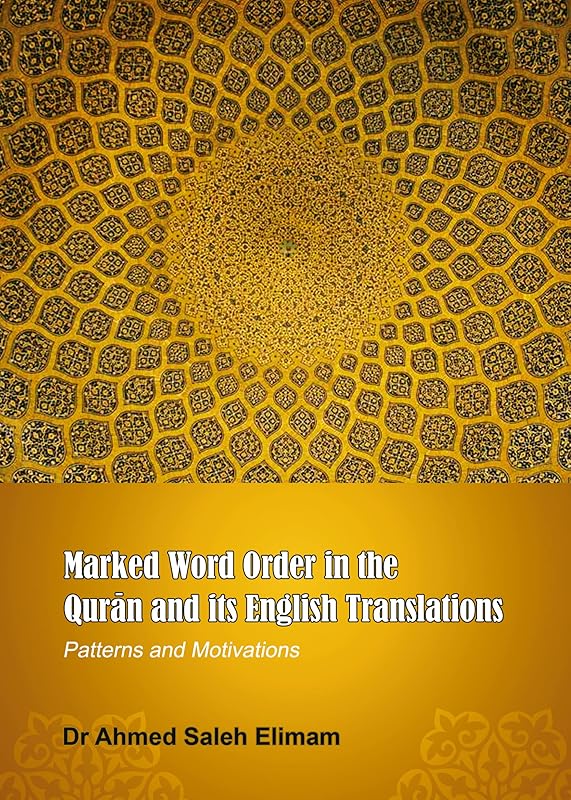
Marked Word Order in the Qur'an and Its English Translations: Patterns and Motivations by Ahmed Saleh Elimam

Marked Word Order in the Qur'an and Its English Translations: Patterns and Motivations

Ahmed Saleh Elimam
284 pages
Cambridge Scholars Publishing
Oct 2013
Hardcover
Reference WSBN
0
Readers
0
Reviews
0
Discussions
0
Quotes
The literature on Balaghah (the art of Arabic eloquence) and commentaries on the Qur'an stress that the style of the Qur'an is "beautiful", "eloquent" and "inimitable". This literature identifies word order as one of the most distinctive aspects of Qur'anic style. One of the main reasons for this is that, compared to English, Arabic has fewer restrictions on word order, thanks to its elaborate verb inflection system and case marking. This flexibility allows for the foregrounding of some elements within the sentence, resulting in a marked (or non-canonical) word order and fulfilling certain discursive functions, including specification, restriction, emphasis, amplification/glorification, and denial. Marked word order is used to highlight or downplay certain elements in speech or writing. It constitutes one way of delivering meanings to the addressee, as these meanings are ordered in the mind of the speaker in terms of their importance, making the style a precise reflection of the speaker's mind and feelings. This book is a descriptive study which attempts to examine how translations of the Qur'an have handled ayahs (verses of the Qur'an) that feature lexical foregrounding, focusing on ten published translations into English, carried out by translators from different ideological and linguistic backgrounds. It offers a systematic comparison of the ways in which the selected translators deal with the linguistic feature of word order variation, and examines issues relating to the translator's style. Specifically, the book identifies and examines the following: instances of marked word order discussed by commentators on the Qur'an, and the function served by each case of lexical foregrounding; secondly, the options and/or patterns employed by translators to render the different functions of marked word order; thirdly, the recurrent options and/or patterns for rendering different types of word order variation. Finally, the book explores the factors which may have influenced the choice of particular strategies by different translators, including the translators' motivations and the various historical contexts in which the translations were made.
Join the conversation

No discussions yet. Join BookLovers to start a discussion about this book!

No reviews yet. Join BookLovers to write the first review!

No quotes shared yet. Join BookLovers to share your favorite quotes!

Earn Points
Your voice matters. Every comment, review, and quote earns you reward points redeemable for Bitcoin.
Comment +5 pts Review +20 pts Quote +7 pts Upvote +1 pt
BookMatch Quiz
Find books similar to this one
About this book
Pages 284
Publisher Cambridge Scholars P...
Published 2013
Readers 0