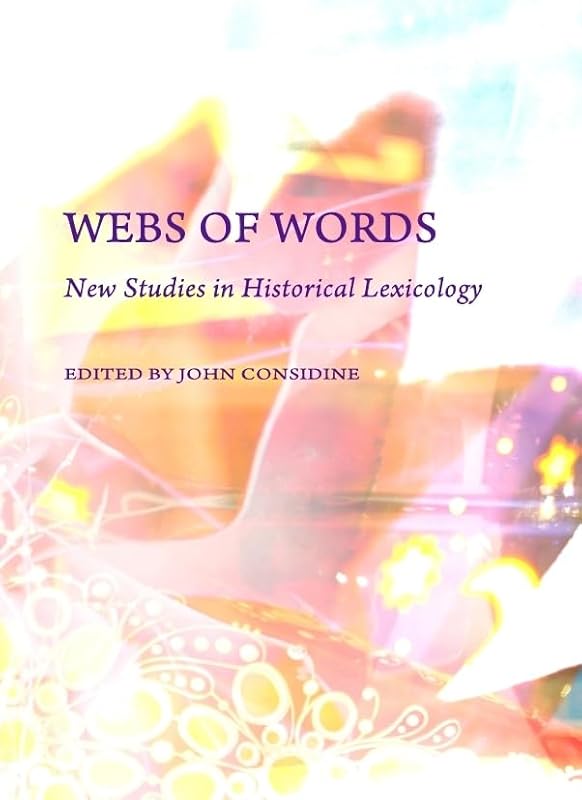
Webs of Words: New Studies in Historical Lexicology by John Considine

Webs of Words: New Studies in Historical Lexicology

John Considine
260 pages
Cambridge Scholars Publishing
Apr 2010
Hardcover
Foreign Languages WSBN
0
Readers
0
Reviews
0
Discussions
0
Quotes
'Webs of Words: New Studies in Historical Lexicology' brings together ten papers on aspects of the history of words and vocabulary, which address aspects of Chinese, Czech, Dutch, English (including Caribbean varieties) , German, Italian, Maori, Persian, Portuguese, Russian, and other languages. In the first four essays, focussing on pre-1800 material, Karel Kucera and Martin Stluka's opening essay discusses the plotting of the relative historical frequency of common words, drawing on their work with the diachronic portion of the Czech National Corpus; Ian Lancashire asks why Tudor England had no monolingual English dictionary; Chiara Benati discusses the interplay between Low German, High German, and Latin in an early modern surgical text, and Mateusz Urban sorts out the competing etymologies of English balcony, Italian balcone, and similar forms in Persian and Russian. The next six turn to more recent material. Jane Samson analyzes the nineteenth-century debate as to whether the Maori language was too primitive to have a word for 'blue'; Vivien Waszink discusses the Dutch prefixes bio- and eco- and their documentation in a new dictionary; Tommaso Pellin examines a series of attempts to provide a grammatical terminology in Chinese; Lise Winer surveys the naming of fauna in the English/Creole of Trinidad and Tobago; Miroslawa Podhajecka writes on the treatment of Russian loanwords in the current revision of the Oxford English Dictionary, with special attention to Google Books as a research tool; and, Isabel Casanova asks whether Portuguese dictionaries should register English words. The contributions to this volume share an interest in empirical evidence rather than in lexicological study at a highly theoretical level, and in the wide contextualization of the words which constitute this evidence in the social and cultural lives of their users.
Join the conversation

No discussions yet. Join BookLovers to start a discussion about this book!

No reviews yet. Join BookLovers to write the first review!

No quotes shared yet. Join BookLovers to share your favorite quotes!

Earn Points
Your voice matters. Every comment, review, and quote earns you reward points redeemable for Bitcoin.
Comment +5 pts Review +20 pts Quote +7 pts Upvote +1 pt
BookMatch Quiz
Find books similar to this one
About this book
Pages 260
Publisher Cambridge Scholars P...
Published 2010
Readers 0