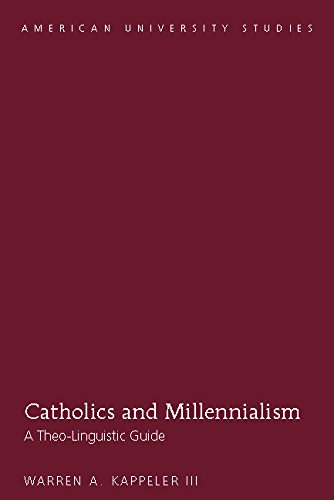
Catholics and Millennialism: A Theo-Linguistic Guide (American University Studies Book 350) by Warren A. Kappeler III

Catholics and Millennialism: A Theo-Linguistic Guide (American University Studies Book 350)

Warren A. Kappeler III
Peter Lang Inc., International Academic Publishers
Jan 2016
Hardcover
Christian Books WSBN
0
Readers
0
Reviews
0
Discussions
0
Quotes
Philosophers of religion such as Mark Kingwell regard millenarian dreams as humanity's most powerful hopes for transformation, transcendence, apocalypse, and utopia. In Catholics and Millennialism: A Theo-Linguistic Guide, Warren A. Kappeler III explores the insights of critical discourse theory to examine the impact of millenarian groups upon Catholics. He examines theo-linguistic practices among present-day Catholics through allegorical interpretation, fundamentalism, and neo-literalism. Utilizing surveys of pre-millennial movements as revealed in academic research by Michael Cuneo, William Dinges, and Sandra Zimdars-Swartz, as well as post-millennial collaboration by progressive Catholics such as Hans Küng, Matthew Fox, and Karen Armstrong; Kappeler argues that apocalyptic stories and media images in today's popular culture promote a self-dramatization that encourages sympathetic Catholics to interpret their life experience within the grammar of the millennium myth.While some commentators argue that the new age audience is driven by populist reasoning inside church history and culture, a critical discourse analysis perspective reveals that millenarian movements have provided a language resource for a great number of social, cultural, and political conflicts in the history of Western civilization. Consequently, the mainstream history of the Catholic Church has been dedicated to the a-millennial viewpoint of Saint Augustine of Hippo. Considering these platforms, Kappeler sketches a mediating position between the church's millennial factions called Proleptic Adventism based upon a dialectical approach to both eschatology and incarnational spirituality. Ultimately Kappeler's findings offer hope to a postmodern world by looking to the future instead of the past, by analyzing popular culture in its dynamism and its contradictions, stressing the spiritual elements of liberation and participation, and by expressing itself in sacramental action and analogical reasoning.
Join the conversation

No discussions yet. Join BookLovers to start a discussion about this book!

No reviews yet. Join BookLovers to write the first review!

No quotes shared yet. Join BookLovers to share your favorite quotes!

Earn Points
Your voice matters. Every comment, review, and quote earns you reward points redeemable for Bitcoin.
Comment +5 pts Review +20 pts Quote +7 pts Upvote +1 pt
BookMatch Quiz
Find books similar to this one
About this book
Publisher Peter Lang Inc., Int...
Published 2016
Readers 0