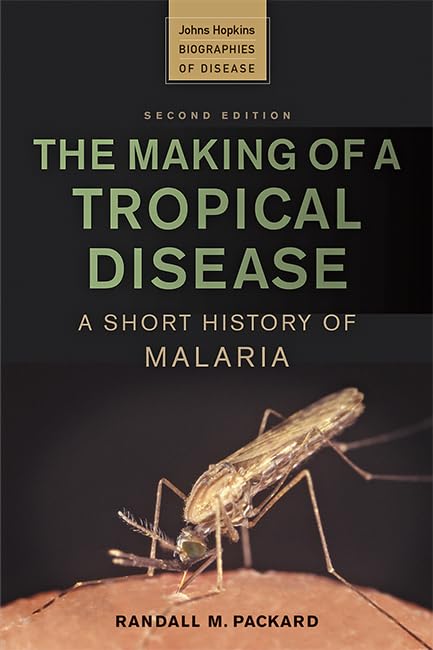
The Making of a Tropical Disease: A Short History of Malaria (Johns Hopkins Biographies of Disease), 2nd edition by Randall M. Packard

The Making of a Tropical Disease: A Short History of Malaria (Johns Hopkins Biographies of Disease), 2nd edition

Randall M. Packard
352 pages
Johns Hopkins University Press
Jul 2021
Paperback
History WSBN
0
Readers
0
Reviews
0
Discussions
0
Quotes

Free account. We’ll keep this book ready while you join.

Find a copy

Formats and availability vary by store. As an Amazon Associate I earn from qualifying purchases.

A global history of malaria that traces the natural and social forces that have shaped its spread and made it deadly, while limiting efforts to eliminate it.Malaria sickens hundreds of millions of people -- and kills nearly a half a million -- each year. Despite massive efforts to eradicate the disease, it remains a major public health problem in poorer tropical regions. But malaria has not always been concentrated in tropical areas. How did malaria disappear from other regions, and why does it persist in the tropics? From Russia to Bengal to Palm Beach, Randall M. Packard's far-ranging narrative shows how the history of malaria has been driven by the interplay of social, biological, economic, and environmental forces. The shifting alignment of these forces has largely determined the social and geographical distribution of the disease, including its initial global expansion, its subsequent retreat to the tropics, and its current persistence. Packard argues that efforts to control and eliminate malaria have often ignored this reality, relying on the use of biotechnologies to fight the disease. Failure to address the forces driving malaria transmission have undermined past control efforts.Describing major changes in both the epidemiology of malaria and efforts to control the disease, the revised edition of this acclaimed history, which was chosen as the 2008 End Malaria Awards Book of the Year in its original printing,* examines recent efforts to eradicate malaria following massive increases in funding and political commitment; * discusses the development of new malaria-fighting biotechnologies, including long-lasting insecticide-treated nets, rapid diagnostic tests, combination artemisinin therapies, and genetically modified mosquitoes; * explores the efficacy of newly developed vaccines; and * explains why eliminating malaria will also require addressing the social forces that drive the disease and building health infrastructures that can identify and treat the last cases of malaria.Authoritative, fascinating, and eye-opening, this short history of malaria concludes with policy recommendations for improving control strategies and saving lives.
Join the conversation

No discussions yet. Join BookLovers to start a discussion about this book!

No reviews yet. Join BookLovers to write the first review!

No quotes shared yet. Join BookLovers to share your favorite quotes!

Earn Points
Your voice matters. Every comment, review, and quote earns you reward points redeemable for Bitcoin.
Comment +5 pts Review +20 pts Quote +7 pts Upvote +1 pt
Similar Books
Find books similar to this one
About this book
Pages 352
Publisher Johns Hopkins Univer...
Published 2021
Readers 0