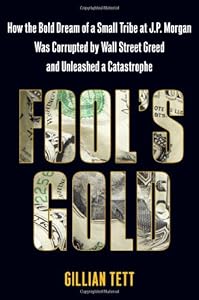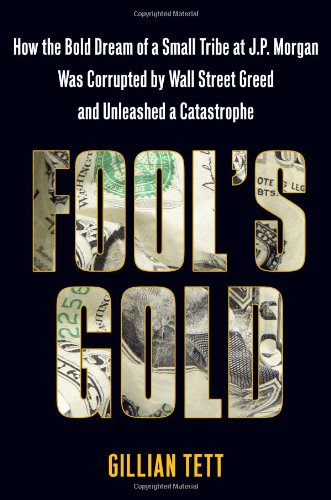
Fool's Gold: How the Bold Dream of a Small Tribe at J.P. Morgan Was Corrupted by Wall Street Greed and Unleashed a Catastrophe by Gillian Tett

Fool's Gold: How the Bold Dream of a Small Tribe at J.P. Morgan Was Corrupted by Wall Street Greed and Unleashed a Catastrophe
Gillian Tett
Free Press; 1 edition
May 2009
Hardcover
WSBN
3
Readers
1
Reviews
0
Discussions
0
Quotes
Drawing on exclusive access to J.P. Morgan CEO Jamie Dimon and a tightly bonded team of bankers known on Wall Street as the "Morgan Mafia"—as well as in-depth interviews with dozens of other key players, including Treasury Secretary Timothy Geithner—Gillian Tett brings to life in gripping detail how the Morgan team's bold ideas for a whole new kind of financial alchemy helped to ignite a revolution in banking, and how that revolution escalated wildly out of control. The deeply reported and lively narrative takes readers behind the scenes, to the inner sanctums of elite finance and to the secretive reaches of what came to be known as the "shadow banking" world. The story begins with the intense Morgan brainstorming session in 1994 beside a pool in Boca Raton, where the team cooked up a dazzling new idea for the exotic financial product known as credit derivatives.
Join the conversation

No discussions yet. Join BookLovers to start a discussion about this book!

"What's aught but as 'tis valued . . . ?"

Gillian Tett was very shrewd in focusing her account of the financial meltdown of 2007-09 on J. P. Morgan. JPM was one of the few banks that came out on the other side looking relatively good, and I surmise that it was because they had acted with a greater degree of restraint and responsibility that they were willing to have Tett tell their story, and I assume that she had a lot of access to almost all the players. At the same time, the focus on JPM didn't impede Tett from giving very clear explanations of key terms -- collateral debt obligations, asset backed securities, derivatives, credit default swaps, monoline insurance, leverage, capitalization, structured investment vehicles, and all the rest. She has a talent not just for clear explanations but for framing analogies that make the transactions understandable to non-experts like me. Of course, her focus on JPM means that we don't get inner views on the operations of, say, Merrill Lynch, Morgan Stanley, and Fannie Mae -- or the Federal Reserve or the Treasury, come to that -- but there are other books that will give you some of that. Sorkin's "Too Big To Fail" has the broader scope, but the downside of his broader approach is that the narrative is a bit diffuse and the character of individual actors less developed. No reason not to read both, however. Tett's focus gives her a chance to shape an arching narrative, for at the beginning we see a group of young JPM bankers disporting themselves in south Florida and in effect inventing credit derivatives. At the end of the book, she brings us back to that group, now dispersed fifteen years later, and wondering what the heck happened. How did a strategy they developed with the aim of dispersing risk end up increasing it? That's the story Tett's telling, and it's clear that at the end she and the original bankers still believe that their invention was a good thing -- a tool, as one of them put it, but one that was used for purposes that the inventors never intended...

No quotes shared yet. Join BookLovers to share your favorite quotes!

Earn Points
Your voice matters. Every comment, review, and quote earns you reward points redeemable for Bitcoin.
Comment +5 pts Review +20 pts Quote +7 pts Upvote +1 pt
BookMatch Quiz
Find books similar to this one
About this book
Publisher Free Press; 1 editio...
Published 2009
Readers 3