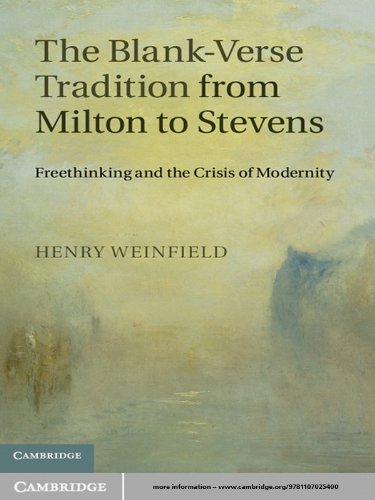
The Blank-Verse Tradition from Milton to Stevens: Freethinking and the Crisis of Modernity by Henry Weinfield

The Blank-Verse Tradition from Milton to Stevens: Freethinking and the Crisis of Modernity

Henry Weinfield
265 pages
Cambridge University Press
Jun 2012
Hardcover
Literature & Fiction WSBN
0
Readers
0
Reviews
0
Discussions
0
Quotes
Blank verse, unrhymed iambic pentameter, has been central to English poetry since the Renaissance. It is the basic vehicle of Shakespeare's plays and the form in which Milton chose to write Paradise Lost. Milton associated it with freedom, and the Romantics, connecting it in turn with freethinking, used it to explore change and confront modernity, sometimes in unexpectedly radical ways. Henry Weinfield's detailed readings of the masterpieces of English blank verse focus on Milton, Wordsworth, Shelley, Keats, Tennyson and Stevens. He traces the philosophical and psychological struggles underlying these poets' choice of form and genre, and the extent to which their work is marked, consciously or not, by the influence of other poets. Unusually attuned to echoes between poems, this study sheds new light on how important poetic texts, most of which are central to the literary canon, unfold as works of art. Read more Continue reading Read less REVIEW
"The Blank-Verse Tradition refreshingly rings with a pure love of these great canonical poems. Such intelligent attention reminds us that they continue to be worth formalist book-length studies."
Review of English Studies

"The author proposes that blank verse as deployed and championed by Milton in Paradise Lost lends itself to not only freedom but to freethinking (by which he means independence of thought) , as evidenced by selected poems by Wordsworth, Keats, Shelley Tennyson and Stevens. The book's strengths lie in much careful explication de texte and in the light shed on many inter-textual linkages."
Archie Burnett, Milton Quarterly

"The very real pleasures of this book are to be found in its resourceful and sensitive readings of very great poems."
Gordon Teskey, Modern Philology --This text refers to the paperback edition. BOOK DESCRIPTION
Blank verse has been central to English poetry since the Renaissance, most famously in Shakespeare's plays and in Paradise Lost. Henry Weinfield's detailed readings of the masterpieces of English blank verse focus on Milton, Wordsworth, Shelley, Keats, Tennyson and Stevens, tracing what lies behind their choice of form. --This text refers to an alternate kindleedition edition. ABOUT THE AUTHOR
Henry Weinfield is a professor in the Program of Liberal Studies at Notre Dame University. --This text refers to the paperback edition. BOOK DESCRIPTION
A detailed study of Milton, Wordsworth, Shelley, Keats, Tennyson and Stevens, tracing what lies behind their choice of blank verse. --This text refers to the paperback edition. Read more Continue reading Read less
Join the conversation

No discussions yet. Join BookLovers to start a discussion about this book!

No reviews yet. Join BookLovers to write the first review!

No quotes shared yet. Join BookLovers to share your favorite quotes!

Earn Points
Your voice matters. Every comment, review, and quote earns you reward points redeemable for Bitcoin.
Comment +5 pts Review +20 pts Quote +7 pts Upvote +1 pt
BookMatch Quiz
Find books similar to this one
About this book
Pages 265
Publisher Cambridge University...
Published 2012
Readers 0