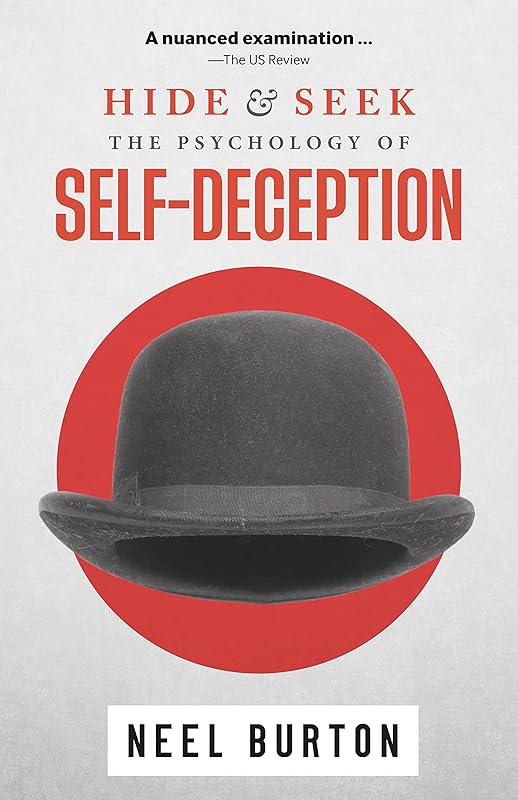

Hide and Seek: The Psychology of Self-Deception (Ataraxia Book 2) by Neel Burton

Hide and Seek: The Psychology of Self-Deception (Ataraxia Book 2)

Neel Burton
208 pages
Acheron Press
Jan 2019
Hardcover
Default WSBN
0
Readers
0
Reviews
0
Discussions
0
Quotes
Start seeing things you never saw.Above all, don't lie to yourself. The man who lies to himself and listens to his own lie comes to a point that he cannot distinguish the truth within him, or around him, and so loses all respect for himself and for others. And having no respect he ceases to love. - DostoevskySelf-deception is common and universal, and the cause of most human tragedies. Of course, the science of self-deception can help us to live better and get more out of life. But it can also cast a murky light on human nature and the human condition, for example, on such exclusively human phenomena as anger, depression, fear, pity, pride, dream making, love making, and god making, not to forget age-old philosophical problems such as selfhood, virtue, happiness, and the good life. Nothing, in the end, could possibly be more important.Burton provides an excellent explanation of how we use psychological defence mechanisms to protect ourselves from painful truths. - The PsychiatristA nuanced examination ... Burton's exploration of self-deception is intellectually appealing, both for readers steeped in psychoanalytic thought and the layperson. An abundance of everyday examples clearly illustrates a range of behaviours, from denial and repression to scapegoating and magical thinking ... - The US Review of Books (Recommended) Burton guides the reader to unlearn, rediscover, and return to wholeness. It is a journey out of Plato's cave... - The International Review of BooksBurton is never short of an interesting and sharp judgment. - Prof Peter Toohey, Psychology TodayI've read many Neel Burton books. He's a wonderful writer and able to immerse you lightly in pretty heavy stuff. - Adrian Bailey, Vine VoiceAbout the authorDr Neel Burton FRSA is a psychiatrist, philosopher, and wine-lover who lives and teaches in Oxford, England. He is a Fellow of Green-Templeton College in the University of Oxford, and the recipient of the Society of Authors' Richard Asher Prize, the British Medical Association's Young Authors' Award, the Medical Journalists' Association Open Book Award, and a Best in the World Gourmand Award. His work has featured in the likes of Aeon and Psychology Today, and been translated into several languages.ContentsIntroduction and OverviewPart I: Abstraction1. Denial2. Repression3. Dissociation4. Intellectualization5. Rationalization6. Positive Illusions7. DepressionPart II: Transformation8. Displacement9. Scapegoating10. Somatization11. Reaction Formation12. Stockholm Syndrome13. Undoing14. Minimization and Exaggeration15. Symbolization and Dream Interpretation16. Reification and the Self17. Magical ThinkingPart III: Evasion through Fraud or Fantasy18. Vagueness19. Inauthenticity20. Reconstruction of Reality21. Confabulation22. Splitting23. Dehumanization24. Daydreaming25. RegressionPart IV: Evasion through People or the World26. Socialization27. Garrulousness28. Dramatization29. Grandiosity30. Humour31. Asceticism32. Sublimation33. Altruism34. Anticipation35. Fear and AnxietyPart V: Projection36. Projection37. Projective Identification38. Idealization39. Devaluation40. IdentificationFinal Words◆ Grab your copy now for a new understanding of yourself and others.

No discussions yet. Join BookLovers to start a discussion about this book!

No reviews yet. Join BookLovers to write the first review!

No quotes shared yet. Join BookLovers to share your favorite quotes!