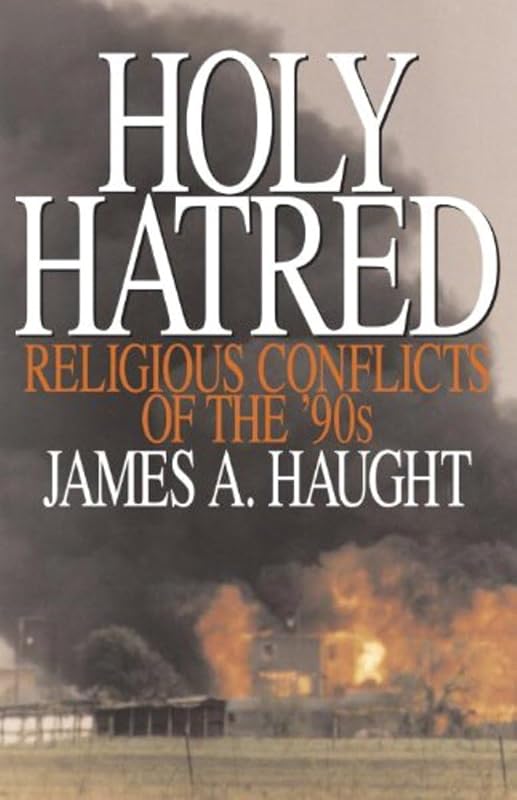
Holy Hatred
James A. Haugt
From the Catholic-Protestant killings in Northern Ireland to the Hindu-Sikh-Muslim massacres in India, from the Orthodox-Catholic-Muslim horror in the former Yugoslavia to the Branch Davidian cult tragedy in Waco, Texas, religion is still a powerful force that pits people against one another. Award-winning journalist James A. Haught has chronicled the many recent surges of religious hostility in this important volume. Read more Continue reading Read less FROM PUBLISHERS WEEKLY
Haught (Holy Horrors) shows that many gruesome acts worldwide and throughout history have been committed "in the name of God." He stresses that religion-inspired atrocities did not end with the Inquisition or the Reformation, and he recalls the Manhattan World Trade Center bombing by Muslim fundamentalists in 1993 and the religiously inspired atrocities in the former Yugoslavia. Haught, noting the "nearly universal pattern" of killing in the name of religion, reviews ongoing hot spots, including Northern Ireland, India and Israel. He also maintains that the influence of Christian fundamentalism is increasing in U.S. politics. For all of his astute observations, however, Haught concludes his exploration of the "evil side of religion" with the pedestrian suggestion that "To find living conditions that are... 'civilized,' avoid places with intense religion." Illustrations not seen by PW.
Copyright 1994 Reed Business Information, Inc. FROM LIBRARY JOURNAL
Newspaper editor and author Haught (Holy Horrors: The History of Religious Murder and Madness, Prometheus, 1990) provides a journalist's compilation of barbarities connected with various religions. The present unrelenting chronicle of atrocities, augmented by over 30 photos and a dozen maps (titles only seen) , covers events in Yugoslavia, Northern Ireland, Sudan, Egypt, New York City, Sri Lanka, Iran, Algeria, and the Caucasus, with special focus on extremist Muslim activity and the Waco, Texas, tragedy. Events are reported through Western eyes without real exploration of the deeper historical, cultural, and indigenous factors woven through all religions and with no distinction made between levels of faith and their human religious expressions. The book concludes with the admonition to "avoid places with intense religion." Although of marginal value, the work points to a perduring irony in human history and serves as a warning for the future.
Anna M. Donnelly, St. John's Univ., New York
Copyright 1995 Reed Business Information, Inc. FROM THE BACK COVER
It is a bitter irony that today millions who claim to be religious - those who counsel peace, advocate the community of humankind, and voice concern for the welfare of others - often perpetrate madness, mayhem, and murder on a grand scale, and all in the name of some "righteous" cause. It would seem that the crusades, inquisitions, and witch hunts of our dark and blood-drenched past have taught us nothing. In just the first few years of the 1990s the world has witnessed Sikh violence against Muslims in India; Serbian Orthodox Christians against Croatian Catholics and Bosnian Muslims in the shattered Yugoslavia; the extremism of Muslim holy laws throughout Africa and the Middle East; Catholics against Protestants in Northern Ireland; the Branch Davidian inferno in Waco, Texas; Hindus and Buddhists engaging in violent clashes in Sri Lanka; and the United States' first real experience of international religious terrorism on its own shores - namely the bombing of the World Trade Center in New York City. These are but a few of the horrific episodes that make so many people question the benign message of modern religion. In Holy Hatred: Religious Conflicts of the 1990s, renowned journalist James A. Haught, author of the widely acclaimed Holy Horrors: An Illustrated History of Religious Murder and Madness, demonstrates in gruesome detail that humanity in general and the world's religions in particular have learned little from the brutal mistakes of their predecessors. Whether it be masses of Hindus storming the gates of a Muslim mosque in India; a car bombing in Belfast; the shotgun murder of an abortion-clinic physician in Florida; "ethnic cleansing" at the hands of Orthodox Serbs inBosnia-Herzegovina; or the bounties placed on the heads of those who dare to question the iron law of Islam; the frightening effects of "fractious faith" can be seen in virtually every part of the globe. But before rational people can join together to develop constructive answers to the conflicts of religious tribalism, which divide nations, communities, and families, the gripping realities of recent years must be acknowledged. ABOUT THE AUTHOR
James A. Haught(Charleston, WV) is the editor of theCharleston Gazette, West Virginia's largest newspaper. He is the author of2000 Years of Disbelief: Famous People with the Couruge to Doubtand four other books. Read more Continue reading Read less