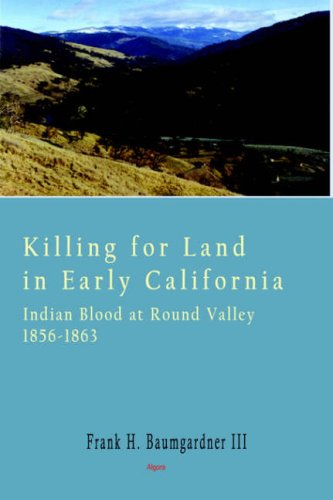
Killing for Land in Early California - Indian Blood at Round Valley
Frank H. Baumgardner
312 pages
Algora Publishing
Jan 2005
Hardcover
Politics
WSBN
The California frontier wars gave land and gold to Whites and reservations to the few surviving Native Americans. Through eyewitness accounts this highly researched work brings to light the graft, greed, and conflicting roles played by the US Army, the State Legislature and the US Congress.
The Round Valley wars of California were an ugly episode in the history of the Westward Expansion, in which Native Americans lost far more than land.
Baumgardner presents a highly researched account of the California frontier wars that gave rise to a stable and permanent ranch economy for whites and a reservation system for the few surviving Native Americans, with a focus on the Nome Cult Farm in remote northeastern Mendocino County, California.
Congress seemed to be on a different track in dealing with the California Indians than both the California state legislature and the Indian Affairs Department. The author emphasizes the vital role played by the US Army and how lack of funding and poor coordination of various levels of government resulted in disaster for the Indians.
The book contains primary material in the form of documents, reports, letters, and depositions or testimony of participants, quoted from the California State Archives and other sources, and numerous eyewitness accounts by participants. Read more Continue reading Read less REVIEW
Under U.S. rule, the Yuki Indians of Northern California s Round Valley region died rapidly. From 1854 to 1864 alone, the Yuki population plunged from as many as twenty thousand (p. 34) to just a few hundred. What accounted for these many deaths? Frank Baumgardner suggests that the primary cause was a bloody conflict (p. 264) . Building on the work of Virginia Miller, Lynwood Carranco, Estle Beard, and other Round Valley historians, Baumgardner attempts to explain how and why a deadly conflict raged that lasted five years and was so very deadly to one side (p. 10) . Baumgardner begins by describing the Yuki and by suggesting that Round Valley violence was part of a larger genocidal struggle between two peoples of vastly different cultures over control of the entire northern half of California (p. 18) . He next describes the establishment of what later became the Round Valley Reservation, the escalated killing of Indians, and settlers , soldiers , and Indian Office officials conflicting views p. 50) over local Indian policy. After narrating Gen. Kibbe s Expedition against other Indians north of the Yuki, Baumgardner describes the zenith of Round Valley violence. In September 1859, after vigilantes led by Walter Jarboe had killed many Indians earlier in the year, the Governor of California hired these men to hunt down Indians beyond the reservation. In total, Jarboe s men killed ... well over four hundred (p. 179) Indians and in 1860 California legislators paid the company over $9,000 for its many deadly raids (pp. 97-8) . Baumgardner next discusses why many settlers supported and participated in Indian killing. He then devotes five chapters to analyzing specific primary sources and four chapters to chronicling the continuing violence and death on and around Round Valley between 1861 and 1864. ...
Baumgardner contributes to our understanding of Round Valley history by bringing previously unutilized primary sources to bear and by adding new context and insights....
In his Preface, he notes that California immigrants . . . with long-range weapons . . . had the power to annihilate entire Native American tribes (p. 2) . He also writes of the genocidal and vigilante type of violence (p. 258) in Northern and Northwestern California. ...Using the definition in the 1948 U.N. Genocide Convention, it is difficult not to interpret Baumgardner s narrative as a history of genocide....Baumgardner documents evidence suggesting whites genocidal intent as well as the killing of many hundreds of Indians, by death squads (p. 57) , paid state militiamen, soldiers, and individual whites in multiple homicides and massacres. By contrast, there is no credible documentation of any Indian articulating intent to destroy the white community, and Baumgardner quotes whites describing local Indians generally peaceful intentions....
Baumgardner s chapter on the California Legislature s 1860 Majority Report of the Special Joint Committee on the Mendocino War might have specifically cited these legislators when they proclaimed: We are unwilling to attempt to dignify, by the term war, a slaughter (California Legislature, Majority and Minority Reports of the Special Joint Committee on the Mendocino Mar, p. 6) . As these men suggested, Round Valley was a site of genocide, not merely a conflict.
Benjamin L. Madley
Yale University
New Haven, Connecticut --Benjamin L. Madley, Yale University
New Haven, Connecticut
Killing for Land in Early California is a fascinating documentary account of a particular period of California history as it played out in Round Valley in Mendocino County in the years between 1856 and 1863 and should be of interest to Californians and non-Californians alike. The author introduces the book as neither a definitive military history nor, strictly speaking, regional history but as a generally accurate summary of what happened and how and why a deadly conflict raged that lasted over five years and was so very deadly to one side. He particularizes the broad sweep of California history by focusing on events that took place during a few years in one location and, in so doing, proves the old adage that the devil is in the details.
While basing his historical account on the documentary record, the author emphasizes that this record is incomplete and essentially flawed, since whatever Native American depositions existed at one time were either lost or destroyed. So, in a very concrete sense, the other side of the story must be read between the lines of the documentary record that does exist. Although before reading this book, I understood that the indigenous p