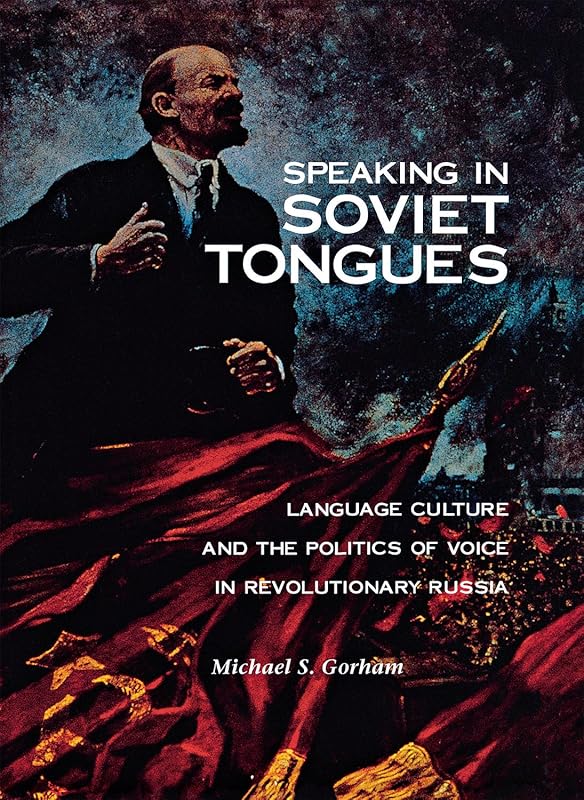
Speaking in Soviet Tongues: Language Culture and the Politics of Voice in Revolutionary Russia (NIU Series in Slavic, East European, and Eurasian Studies) by Michael S. Gorham

Speaking in Soviet Tongues: Language Culture and the Politics of Voice in Revolutionary Russia (NIU Series in Slavic, East European, and Eurasian Studies)

Michael S. Gorham
277 pages
Northern Illinois University Press
Jun 2003
Hardcover
Foreign Languages WSBN
0
Readers
0
Reviews
0
Discussions
0
Quotes
From the classical dialogues of Plato to current political correctness, manipulating language to advance a particular set of values and ideas has been a time-honored practice. During times of radical social and political change, the terms of debate themselves become sharply contested: how people reject, redefine, and reappropriate key words and phrases gives important symbolic shape to their vision of the future. Especially in cataclysmic times, who one is or wants to be is defined by how one writes and speaks. The language culture of early Soviet Russia marked just such a tenuous state of symbolic affairs. Partly out of necessity, partly in the spirit of change, Bolshevik revolutionaries cast off old verbal models of identity and authority and replaced them with a cacophony of new words, phrases, and communicative contexts intended to define and help legitimatize the new Soviet order. Pitched to an audience composed largely of semiliterate peasants, however, the new Bolshevik message often fell on deaf ears. Embraced by numerous sympathetic and newly empowered citizens, the voice of Bolshevism also evoked a variety of less desirable reactions, ranging from confusion and willful subversion to total disregard. Indeed, the earliest years of Bolshevik rule produced a communication gap that held little promise for the makings of a proletarian dictatorship. This gap drew the attention of language authorities - most notably Maxim Gorky - and gave rise to a society-wide debate over the appropriate voice of the new Soviet state and its citizenry. Drawing from history, literature, and sociology, Gorham offers the first comprehensive, interdisciplinary analysis of this critical debate, demonstrating how language ideologies and practices were invented, contested, and redefined. Speaking in Soviet Tongues shows how early Soviet language culture gave rise to unparalleled verbal creativity and utopian imagination while sowing the seeds for perhaps the most notorious forms of Orwellian "newspeak" known to the modern era.
Join the conversation

No discussions yet. Join BookLovers to start a discussion about this book!

No reviews yet. Join BookLovers to write the first review!

No quotes shared yet. Join BookLovers to share your favorite quotes!

Earn Points
Your voice matters. Every comment, review, and quote earns you reward points redeemable for Bitcoin.
Comment +5 pts Review +20 pts Quote +7 pts Upvote +1 pt
BookMatch Quiz
Find books similar to this one
About this book
Pages 277
Publisher Northern Illinois Un...
Published 2003
Readers 0