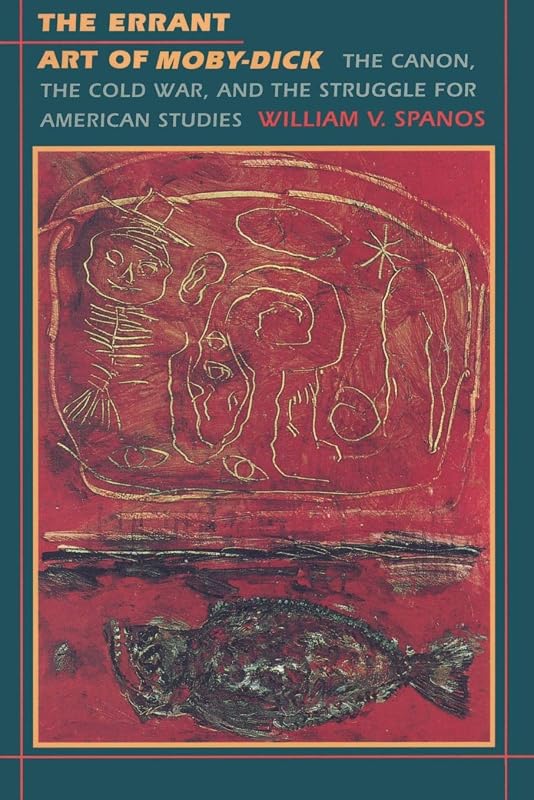
The Errant Art of Moby-Dick: The Canon, the Cold War, and the Struggle for American Studies (New Americanists) by William V. Spanos

The Errant Art of Moby-Dick: The Canon, the Cold War, and the Struggle for American Studies (New Americanists)

William V. Spanos
392 pages
Duke University Press Books
Jun 1995
Paperback
History WSBN
0
Readers
0
Reviews
0
Discussions
0
Quotes

Free account. We’ll keep this book ready while you join.

Find a copy

Formats and availability vary by store. As an Amazon Associate I earn from qualifying purchases.

In The Errant Art of Moby-Dick, one of America's most distinguished critics reexamines Melville's monumental novel and turns the occasion into a meditation on the history and implications of canon formation. In Moby-Dick - a work virtually ignored and discredited at the time of its publication - William V. Spanos uncovers a text remarkably suited as a foundation for a "New Americanist" critique of the ideology based on Puritan origins that was codified in the canon established by "Old Americanist" critics from F. O. Matthiessen to Lionel Trilling. But Spanos also shows, with the novel still as his focus, the limitations of this "New Americanist" discourse and its failure to escape the totalizing imperial perspective it finds in its predecessor.Combining Heideggerian ontology with a sociopolitical perspective derived primarily from Foucault, the reading of Moby-Dick that forms the center of this book demonstrates that the traditional identification of Melville's novel as a "romance" renders it complicitous in the discourse of the Cold War. At the same time, Spanos shows how New Americanist criticism overlooks the degree to which Moby-Dick anticipates not only America's self-representation as the savior of the world against communism, but also the emergent postmodern and anti-imperial discourse deployed against such an image. Spanos's critique reveals the extraordinary relevance of Melville's novel as a post-Cold War text, foreshadowing not only the self-destructive end of the historical formation of the American cultural identity in the genocidal assault on Vietnam, but also the reactionary labeling of the current era as "the end of history."This provocative and challenging study presents not only a new view of the development of literary history in the United States, but a devastating critique of the genealogy of ideology in the American cultural establishment.
Join the conversation

No discussions yet. Join BookLovers to start a discussion about this book!

No reviews yet. Join BookLovers to write the first review!

No quotes shared yet. Join BookLovers to share your favorite quotes!

Earn Points
Your voice matters. Every comment, review, and quote earns you reward points redeemable for Bitcoin.
Comment +5 pts Review +20 pts Quote +7 pts Upvote +1 pt
Similar Books
Find books similar to this one
About this book
Pages 392
Publisher Duke University Pres...
Published 1995
Readers 0