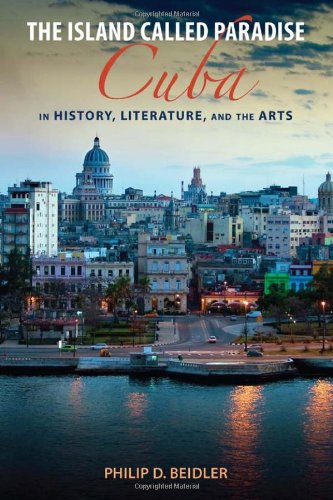
The Island Called Paradise: Cuba in History, Literature, and the Arts by Philip D Beidler

The Island Called Paradise: Cuba in History, Literature, and the Arts

Philip D Beidler
193 pages
The University of Alabama Press
Feb 2014
History WSBN
0
Readers
0
Reviews
0
Discussions
0
Quotes
A personal and cultural mediation, Philip D. Beidler's <i>The Island Called Paradise</i> explores the fascinating ways Cuban history and culture have permeated North American consciousness, and vice versa.<br><br> In <i>The Island Called Paradise</i>, Philip D. Beidler shares his personal discovery of the vast, rich, and astonishing history of the island of Cuba and the interrelatedness of Cuba and the US.<br><br> Cuba first entered Beidler's consciousness in the early 1960s when he watched with mesmerized anxiety the televised reports of the Cuban missile crisis, a conflict that reduced a multifaceted, centuries-old history between North America and Cuba to the stark duotones of Cold War politics. Fifty years later, when Beidler traveled to the US's island neighbor, he found a Cuba unlike the nation portrayed in truculent political rhetoric or in the easy preconceptions of US popular culture. Instead he found an entrancing people and landscape with deep historical connections to the US and a dazzling culture that overwhelmed his creative spirit.<br><br> In twelve original essays, Beidler reintroduces to English-speaking readers many of the central figures, both real and literary, of Cuban and Cuban-American history. Meet Cecilia Valdés, the young mixed-race heroine of a 1839 novel that takes readers to the poor streets and sumptuous salons of Spanish colonial Cuba, and Narciso López, a real-life Venezuelan adventurer and <i>filibustero</i> who attempted to foment a Cuban uprising against Spain. Both would have been familiar figures to nineteenth-century Americans. Beidler also visits the twentieth-century lives of &quot;the two Ernestos&quot; (Ernest Hemingway and Che Guevara) , and the pop-culture Cuban icon Ricky Ricardo.<br><br> A country not with one history but multiple layers of history, Cuba becomes a fertile island for Beidler's exploration. Art, he argues, perpetually crosses walls erected by politics, history, and nationality. At its core, <i>The Island Called Paradise</i> renews and refreshes our knowledge of an older Atlantic world even as we begin to envision a future in which the old bonds between our nations may be restored.
Join the conversation

No discussions yet. Join BookLovers to start a discussion about this book!

No reviews yet. Join BookLovers to write the first review!

No quotes shared yet. Join BookLovers to share your favorite quotes!

Earn Points
Your voice matters. Every comment, review, and quote earns you reward points redeemable for Bitcoin.
Comment +5 pts Review +20 pts Quote +7 pts Upvote +1 pt
BookMatch Quiz
Find books similar to this one
About this book
Pages 193
Publisher The University of Al...
Published 2014
Readers 0

More by Philip D Beidler

View All