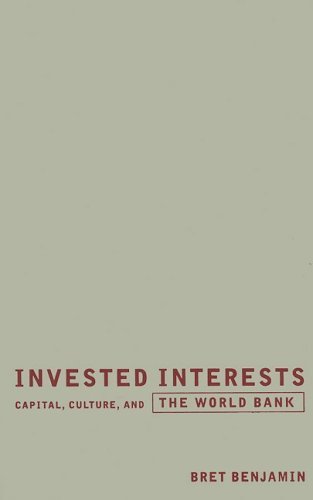
Invested Interests: Capital, Culture, and the World Bank by Bret Benjamin

Invested Interests: Capital, Culture, and the World Bank

Bret Benjamin
296 pages
Univ Of Minnesota Press
Jun 2007
Paperback
Business & Investing WSBN
0
Readers
0
Reviews
0
Discussions
0
Quotes
Despite the World Bank's profound impact on economic, political, and social conditions during the post-World War II era, cultural critics who rigorously theorize other institutions of colonialism and globalization have largely ignored the institution. Working to correct this blind spot, Bret Benjamin's Invested Interests presents the first extended cultural analysis of the World Bank.In Invested Interests, Benjamin contends that the World Bank has, from its inception, trafficked in culture. From the political context in which the Bank was chartered to its evolution into an interventionist development agency with vast, unchecked powers, Benjamin explores the Bank's central role in the global dissemination of Fordist-Keynesianism, its conflicted support for nationalism and the nation-state, and its emerging awareness of the relationships between economics and culture. Benjamin argues that the Bank shapes, and is in turn shaped by, historical pressures of the age - most significantly the rise of third world national liberation movements. Reading a broad array of midcentury archival materials, Benjamin examines not only the Bank's own growing attentiveness to cultural work but also its prominent place in the thinking of such anti-imperialist intellectuals as Aimé Césaire, Frantz Fanon, and Richard Wright.Benjamin maps the Bank's contemporary rhetorical maneuvering in the wake of ever-intensifying protests, offering close readings of the World Bank's corporate literature, the activities of the antiglobalization World Social Forum, and the writings of prominent Bank critic Arundhati Roy, including her novel The God of Small Things.Deftly investigating the World Bank's ideological struggles over six decades, Invested Interests develops a conceptually and politically nuanced critique of the Bank as a cultural institution deeply enmeshed in the last century's historical transformations of imperial power and anti-imperial struggle.Bret Benjamin is associate professor of English and director of undergraduate studies at the University of Albany, SUNY.
Join the conversation

No discussions yet. Join BookLovers to start a discussion about this book!

No reviews yet. Join BookLovers to write the first review!

No quotes shared yet. Join BookLovers to share your favorite quotes!

Earn Points
Your voice matters. Every comment, review, and quote earns you reward points redeemable for Bitcoin.
Comment +5 pts Review +20 pts Quote +7 pts Upvote +1 pt
BookMatch Quiz
Find books similar to this one
About this book
Pages 296
Publisher Univ Of Minnesota Pr...
Published 2007
Readers 0