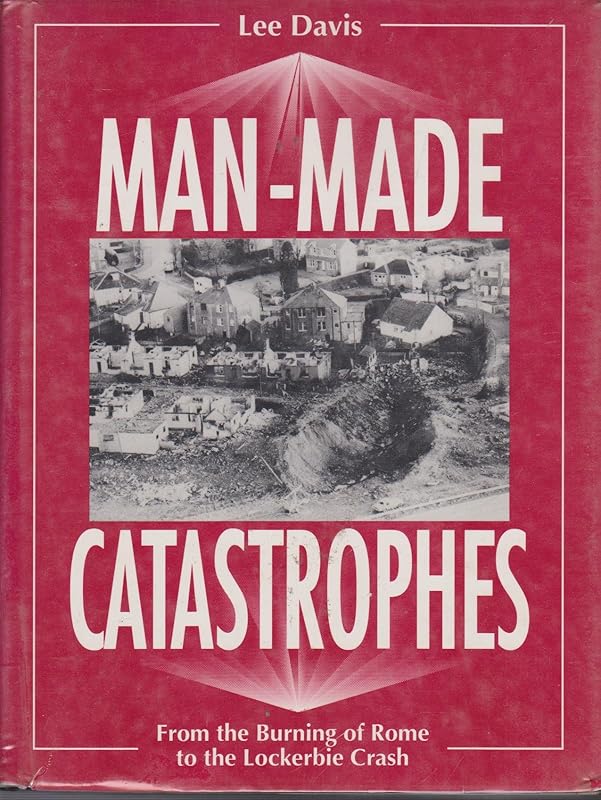






Man-Made Catastrophes: From the Burning of Rome to the Lockerbie Crash by Lee Davis

Man-Made Catastrophes: From the Burning of Rome to the Lockerbie Crash

Lee Davis
Facts on File
Jan 1991
Hardcover
Default WSBN
0
Readers
0
Reviews
0
Discussions
0
Quotes
From the burning of Rome to the 1989 Lockerbie crash, Man-made catastrophes offers a comprehensive world survey of man-made disasters that have devastated our world and even altered the course of human history. The more than 280 entries included in this volume encompass a wide range of events, including fires, explosions, railway disasters, maritime disasters, civil unrest and terrorism, space disasters, nuclear and industrial accidents, and air crashes.For easy reference, the book is organized by disaster type, with a general introduction of each category preceding the entries on individual events. In addition to providing the basic facts of each disaster, the lively text offers insight into the background of each event as well as the ultimate impact on mankind and the environment. Highlighted throughout are eyewitness accounts, and helpful chronologies provide information at a glance.Highlights from Man-made Catastrophes:The most tragic maritime disaster of all time occurred in the Baltic Sea in 1945 when an unidentified Soviet submarine torpedoed the Wilhelm Gustloff, loaded with refugees. While the death toll from this incident is estimated to be nearly five times the number of fatalities in the Titanic tragedy, this disaster has gone virtually unrecorded.One of the most bizarre airplane accidents happened on July 28, 1945 when a U.S. Army Air Corps B-25 bomber flying in heavy fog collided with New York's Empire State Building.The worst train wreck in India's history was caused by an engineer's decision to brake for a cow on the tracks. This 1981 incident near Mansi resulted in more than 560 deaths.Following the 1986 explosion at the Chernobyl nuclear power plant, a sarcophagus was built to contain the waste of 171 tons of coagulated and resolidified fuel, which will remain radioactive and dangerous for at least 150 years. The 20-story-high structure of concrete and steel has a life span of only 25 years.Authoritative and comprehensive, Man-made Catastrophes will be an important source for students, researchers and historians.
Join the conversation

No discussions yet. Join BookLovers to start a discussion about this book!

No reviews yet. Join BookLovers to write the first review!

No quotes shared yet. Join BookLovers to share your favorite quotes!

Earn Points
Your voice matters. Every comment, review, and quote earns you reward points redeemable for Bitcoin.
Comment +5 pts Review +20 pts Quote +7 pts Upvote +1 pt
BookMatch Quiz
Find books similar to this one
About this book
Publisher Facts on File
Published 1991
Readers 0