Lost Cause of Rhetoric: The Relation of Rhetoric and Geometry in Aristotle and Lacan by Assistant Professor David Metzger

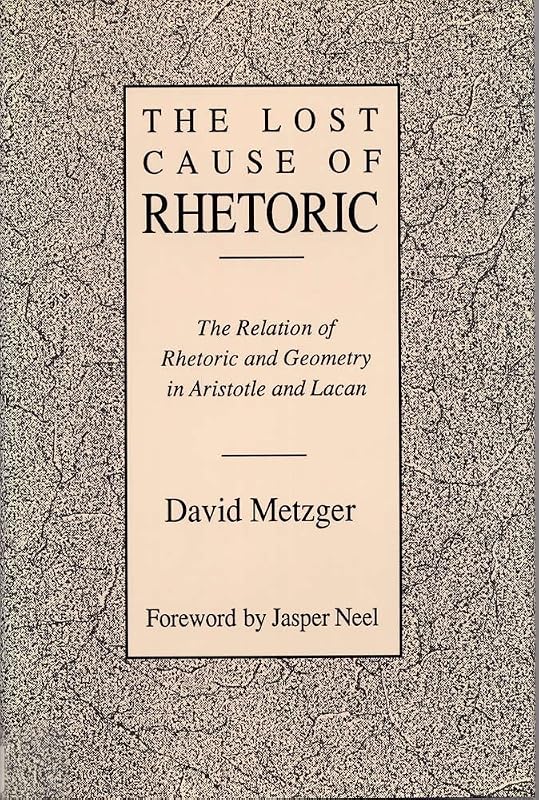
Lost Cause of Rhetoric: The Relation of Rhetoric and Geometry in Aristotle and Lacan

Assistant Professor David Metzger
160 pages
Southern Illinois University Press
Jan 1995
Hardcover
Foreign Languages WSBN
0
Readers
0
Reviews
0
Discussions
0
Quotes
In this brilliant study of the relationship between rhetoric and geometry, David Metzger boldly poses and answers questions of major significance to the field of rhetorical studies. By asking what rhetoric is, he examines why ithas always been difficult to define and to determine its purpose and value. Metzger seeks to ascertain how rhetoric can be more clearly valued and therefore better understood, both on its own and as a set of tools with which to write and think.Metzger explores the nature of knowledge in terms of what is created in the relationship between rhetoric and geometry, noting how rhetoric is eliminated in the epistemology of Western culture and how it can he replaced through geometry in the places vacated by philosophy. He argues that the dismissal of the "here and now" (and thus the dismissal of rhetoric itself) takes the form of two basic philosophical moves: the onomastic, which dismisses rhetoric because it is not philosophic, not geometry, and the genealogical, which dismisses rhetoric because it is philosophic, not geometry. Using Descartes's cogito and Derrida's discussion of genre as examples of these two philosophical moves, Metzger introduces the work of Aristotle and Lacan as their counter-examples. He then argues that rhetoric is about the present. For Aristotle, rhetoric is a dunamis, a faculty and potentiality, but not a potentiality with reference to the future. For Lacan, rhetoric is a means of delineating, through the laws of metaphor and metonymy, the instance of the letter, the instant(s) or "nowness" of the unconscious understood as a zeitloss, a tireless worker. For both Aristotle and Lacan, the formal properties of rhetoric appear in rhetoric's relation to geometry.Metzger points out that contemporary researchers in rhetoric often assume a definition of rhetoric for the purpose of classification; distinguishing, for instance, among a medieval rhetoric, a feminist rhetoric, or a phenomenological rhetoric. This kind of research, he believes, examines rhetoric in terms of what itwas or might be, but not in terms of what itactually is.As the first postmodern discussion of the relation of rhetoric and time, Metzger's book examines rhetoric as itis, breaking new ground as a study of Aristotle's notion of faculty (dunamis) , of Lacanian rhetoric, and of the relation of rhetoric and geometry as itdoes so. It is a book for all theorists (particularly poststructuralist theorists and others eager to know more about Lacan) , Lacanians who have ignored Lacan's relevance to rhetoric, and historians critical of the division, in modern rhetorical studies, between theory and history.
Join the conversation

No discussions yet. Join BookLovers to start a discussion about this book!

No reviews yet. Join BookLovers to write the first review!

No quotes shared yet. Join BookLovers to share your favorite quotes!

Earn Points
Your voice matters. Every comment, review, and quote earns you reward points redeemable for Bitcoin.
Comment +5 pts Review +20 pts Quote +7 pts Upvote +1 pt
BookMatch Quiz
Find books similar to this one
About this book
Pages 160
Publisher Southern Illinois Un...
Published 1995
Readers 0