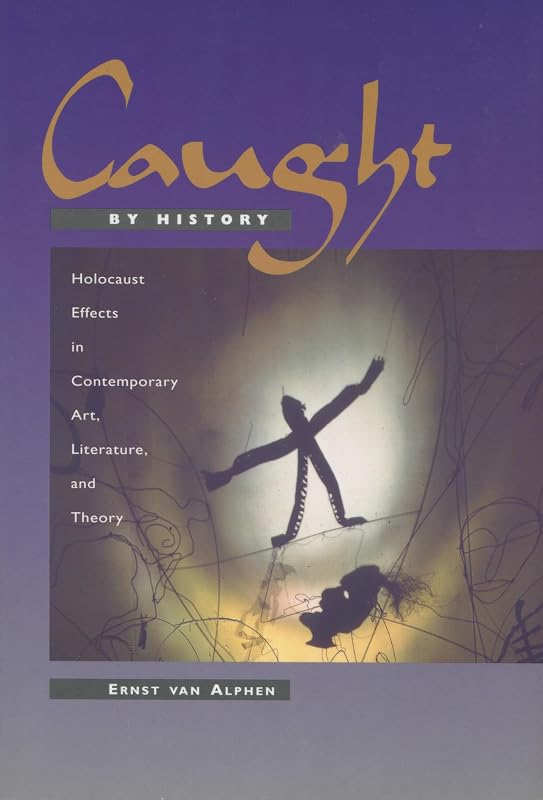
Caught by History: Holocaust Effects in Contemporary Art, Literature, and Theory
Ernst van Alphen
In the face of strong moral and aesthetic pressure to deal with the Holocaust in strictly historical and documentary modes, this book discusses why and how reenactment of the Holocaust in art and imaginative literature can be successful in simultaneously presenting, analyzing, and working through this apocalyptic moment in human history.
In pursuing his argument, the author explores such diverse materials and themes as: the testimonies of Holocaust survivors; the works of such artists and writers as Charlotte Salomon, Christian Boltanski, and Armando; and the question of what it means to live in a house built by a jew who was later transported to the death camps. He shows that reenactment, as an artistic project, also functions as a critical strategy, one that, unlike historical methods requiring a mediator, speaks directly to us and lures us into the Holocaust.
We are then placed in the position of experiencing and being the subjects of that history. We are there, and history is present -- but not quite. A confrontation with Nazism or with the Holocaust by means of a re-enactment takes place within the representational realm of art. Our access to this past is no longer mediated by the account of a witness, by a narrator, by the eye of a photographer. We do not respond to a re-presentation of the historical event, but to a presentation or performance of it, and our response is direct or firsthand in a different way. That different way of "keeping in touch" is the subject of inquiry that propels this study.
Read more Continue reading Read less FROM LIBRARY JOURNAL
Van Alphen, director of communication and education at the Museum Boijmans van Beuningen in Rotterdam, takes three artists?Charlotte Salomon, Christian Boltanski, and Armando?and uses their works to describe the nature of artistic production after Auschwitz. He sees tragedies of narrative technique and historic imagination as cultural artifacts in dealing with human catastrophe and representation, mimesis, and reenactment as three significant methods of describing the indescribable. Salomon is carefully described as an artist of resistance, while French artist Boltanski is presented as an exemplar of archival art. The Dutch writer Armando uses the war as a metaphoric statement, as an index to reality. The last chapter is van Alphen's experience, both uncanny and sublime, of living in the house of a Holocaust victim. A difficult subject, well reasoned and thought out; recommended for academic libraries.?Gene Shaw, NYPL
Copyright 1998 Reed Business Information, Inc. REVIEW
"Caught by History is a finely balanced, scholarly narrative of van Alphen's encounters with Holocaust literature, testimony, and art. It brings to our attention little-known artists, and tackles convincingly the bothersome issue of the validity of art in the face of catastrophe, and particularly this catastrophe." -- Geoffrey Hartman -- Yale University. FROM THE INSIDE FLAP
In the face of strong moral and aesthetic pressure to deal with the Holocaust in strictly historical and documentary modes, this book discusses why and how reenactment of the Holocaust in art and imaginative literature can be successful in simultaneously presenting, analyzing, and working through this apocalyptic moment in human history.
In pursuing his argument, the author explores such diverse materials and themes as: the testimonies of Holocaust survivors; the works of such artists and writers as Charlotte Salomon, Christian Boltanski, and Armando; and the question of what it means to live in a house built by a jew who was later transported to the death camps. He shows that reenactment, as an artistic project, also functions as a critical strategy, one that, unlike historical methods requiring a mediator, speaks directly to us and lures us into the Holocaust.
We are then placed in the position of experiencing and being the subjects of that history. We are there, and history is present - but not quite. A confrontation with Nazism or with the Holocaust by means of a re-enactment takes place within the representational realm of art. Our access to this past is no longer mediated by the account of a witness, by a narrator, by the eye of a photographer. We do not respond to a re-presentation of the historical event, but to a presentation or performance of it, and our response is direct or firsthand in a different way. That different way of "keeping in touch" is the subject of inquiry that propels this study.
FROM THE BACK COVER
"Caught by History is a finely balanced, scholarly narrative of van Alphen's encounters with Holocaust literature, testimony, and art. It brings to our attention little-known artists, and tackles convincingly the bothersome issue of the validity of art in the face of catastrophe, and particularly this catastrophe." - Geoffrey Hartman, Yale University. Read more Continue reading Read less