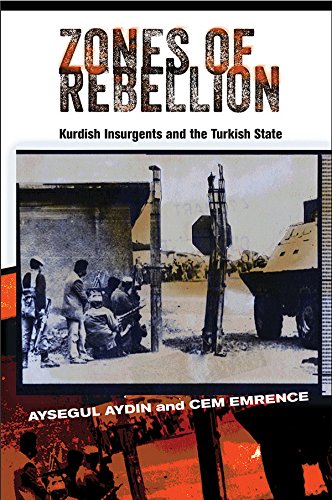
Zones of Rebellion: Kurdish Insurgents and the Turkish State by Aysegul Aydin

Zones of Rebellion: Kurdish Insurgents and the Turkish State

Aysegul Aydin
213 pages
Cornell University Press
Jun 2015
Hardcover
Politics WSBN
0
Readers
0
Reviews
0
Discussions
0
Quotes
How do insurgents and governments select their targets? Which ideological discourses and organizational policies do they adopt to win civilian loyalties and control territory? Aysegul Aydin and Cem Emrence suggest that both insurgents and governments adopt a wide variety of coercive strategies in war environments. Zones of Rebellion integrates Turkish-Ottoman history with social science theory and unveils long-term policies that continue to inform the distribution of violence in Anatolia. The authors show the astonishing similarity in combatants' practices over time and their resulting inability to consolidate Kurdish people and territory around their respective political agendas.The Kurdish insurgency in Turkey is one of the longest-running civil wars in the Middle East. For the first time, Zones of Rebellion demonstrates how violence in this conflict has varied geographically. Identifying distinct zones of violence, Aydin and Emrence show why Kurds and Kurdish territories have followed different political trajectories, guaranteeing continued strife between Kurdish insurgents and the Turkish state in an area where armed groups organized along ethnic lines have battled the central state since Ottoman times.Aydin and Emrence present the first empirical analysis of Kurdish insurgency, relying on original data. These new datasets include information on the location, method, timing, target, and outcome of more than ten thousand insurgent attacks and counterinsurgent operations between 1984 and 2008. Another data set registers civilian unrest in Kurdish urban centers for the same period, including nearly eight hundred incidents ranging from passive resistance to active challenges to Turkey's security forces. The authors argue that both state agents and insurgents are locked into particular tactics in their conduct of civil war and that the inability of combatants to switch from violence to civic politics leads to a long-running stalemate. Such rigidity blocks negotiations and prevents battlefield victories from being translated into political solutions and lasting agreements.
Join the conversation

No discussions yet. Join BookLovers to start a discussion about this book!

No reviews yet. Join BookLovers to write the first review!

No quotes shared yet. Join BookLovers to share your favorite quotes!

Earn Points
Your voice matters. Every comment, review, and quote earns you reward points redeemable for Bitcoin.
Comment +5 pts Review +20 pts Quote +7 pts Upvote +1 pt
BookMatch Quiz
Find books similar to this one
About this book
Pages 213
Publisher Cornell University P...
Published 2015
Readers 0