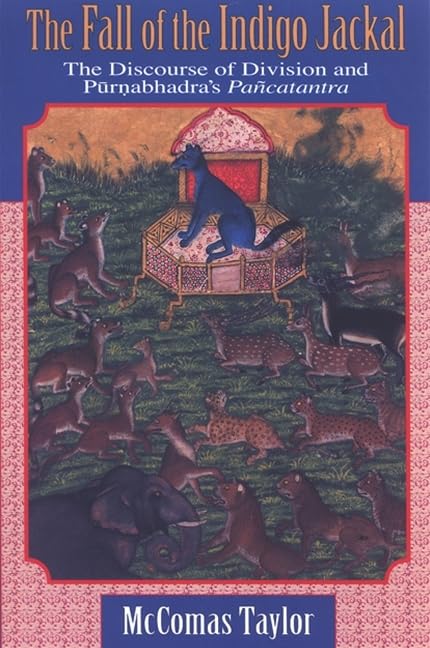
Every child growing up in India knows the story of the jackal who fell into the vat of blue dye, and discovering the power of his majestic new appearance, declared himself king of the forest. In spite of his pretenses, the jackal, eventually betrayed by his own instincts, was set upon by the other animals. This and many similar narratives are found in the Pañcatantra, the collection of Sanskrit tales for children compiled by a Jaina monk named Pur?abhadra in 1199 CE.
In this book, McComas Taylor looks at the discourses that give shape and structure to the fall of the indigo jackal and the other tales within the Pañcatantra. The work's fictional metasociety of animals, kings, and laundrymen are divided according to their jati, or "kind." This discourse of caste holds that individuals' essential natures, statuses, and social circles are all determined by their birth. Taylor applies contemporary critical theory developed by Foucault, Bourdieu, Barthes, and others to show how these ideas are related to other Sanskritic master-texts, and describes the "regime of truth" that provides validation for the discourse of division. Read more Continue reading Read less REVIEW
"...very interesting and innovative ... Taylor's study has provided us with a new angle for methodology that will ensure the continuous progression of our field of study." -- Journal of Asian Studies"This is a fine piece of scholarship. Nothing like this exists for the Indian folklore tradition. McComas Taylor presents the multifaceted significance of the Pañcatantra, which is possibly the most popular book within India. The stories from this collection spread across the world, so this book is also significant for the global study of folktales." -- Patrick Olivelle, translator and editor of The Pañcatantra The Book of India's Folk Wisdom
FROM THE BACK COVER
Every child growing up in India knows the story of the jackal who fell into the vat of blue dye, and discovering the power of his majestic new appearance, declared himself king of the forest. In spite of his pretenses, the jackal, eventually betrayed by his own instincts, was set upon by the other animals. This and many similar narratives are found in the Pancatantra, the collection of Sanskrit tales for children compiled by a Jaina monk named Purnabhadra in 1199 CE.
In this book, McComas Taylor looks at the discourses that give shape and structure to the fall of the indigo jackal and the other tales within the Pancatantra. The work's fictional metasociety of animals, kings, and laundrymen are divided according to their jati, or "kind." This discourse of caste holds that individuals' essential natures, statuses, and social circles are all determined by their birth. Taylor applies contemporary critical theory developed by Foucault, Bourdieu, Barthes, and others to show how these ideas are related to other Sanskritic master-texts, and describes the "regime of truth" that provides validation for the discourse of division.
"This is a fine piece of scholarship. Nothing like this exists for the Indian folklore tradition. McComas Taylor presents the multifaceted significance of the Pancatantra, which is possibly the most popular book within India. The stories from this collection spread across the world, so this book is also significant for the global study of folktales." -- Patrick Olivelle, translator and editor of The Pancatantra: The Book of India's Folk Wisdom
ABOUT THE AUTHOR
McComas Taylor is Head of the South Asia Centre, Faculty of Asian Studies at the Australian National University. Read more Continue reading Read less