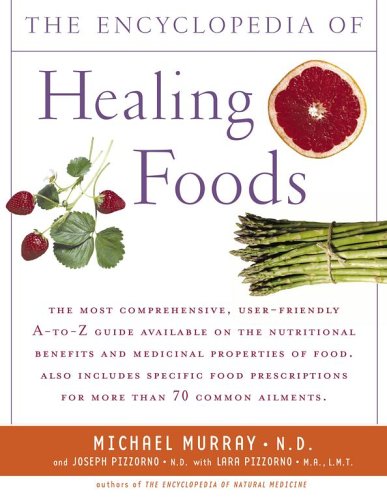
The Encyclopedia of Healing Foods
Michael T. Murray
About the Author Michael T. Murray, N.D., is widely regarded as one of the world?s leading authorities on natural medicine. He has been featured on numerous television programs, including 20/20 and Dateline. He lives in Washington.Dr. Joseph Pizzorno is cofounder of Bastyr University, the first accredited multidisciplinary university of natural medicine in the United States.Lara Pizzorno, M.A., L.M.T., is a health writer and medical editor with more than twenty years of experience. Excerpt. © Reprinted by permission. All rights reserved. Chapter One: Human Nutrition: An Evolutionary Perspective In order to answer the question "What is a healthy diet?," it is important to first take a look at what our body is designed for. Is the human body designed to eat plant foods, animal foods, or both? Respectively, are we herbivores, carnivores, or omnivores? While the human gastrointestinal tract is capable of digesting both plant and animal foods, there are indications that we evolved to digest primarily plant foods. Specifically, our teeth are composed of twenty molars, which are perfect for crushing and grinding plant foods, along with eight front incisors, which are well suited for biting into fruits and vegetables. Only our front four canine teeth are designed for meat eating, and our jaws swing both vertically to tear and laterally to crush, while carnivores' jaws swing only vertically. Additional evidence that supports the human body's preference for plant foods is the long length of the human intestinal tract. Carnivores typically have a short bowel, while herbivores have a bowel length proportionally comparable to humans'. To answer the question of what humans should eat, many researchers look to other primates, such as chimpanzees, monkeys, and gorillas. These nonhuman wild primates are omnivores. They are also often described as herbivores and opportunistic carnivores in that although they eat mainly fruits and vegetables, they may also eat small animals, lizards, and eggs if given the opportunity. For example, the gorilla and the orangutan eat only 1 percent and 2 percent of animal foods as a percentage of total calories, respectively. The remainder of their diet is derived from plant foods. Since humans are between the weight of the gorilla and orangutan, it has been suggested that humans are designed to eat around 1.5 percent of their diet in the form of animal foods. However, most Americans derive well over 50 percent of their calories from animal foods. Since wild primates fill up on wild fruit and other highly nutritious plant foods, those weighing one tenth the amount of a typical human ingest nearly ten times the level of vitamin C and much higher amounts of many other vitamins and minerals (see Table 1.1). How is this possible? One reason is that the cultivated fruit in an American supermarket is far different from the wild fruit of the primate's diet, having a slightly higher protein content and a higher content of certain essential vitamins and minerals. Cultivated fruit tends to be higher in sugars and, while very tasty to humans, it is not nearly as nutritious. In fact, it raises blood sugar levels much more quickly than its wild counterparts do. There are other differences in the wild primate diet that are also important to highlight, such as a higher ratio of alpha-linolenic acid -- the essential omega-3 fatty acid -- to linoleic acid -- the essential omega-6 fatty acid. A higher ratio of omega-3 fatty acid decreases the likelihood of the development of inflammatory and chronic diseases as well as their severity. Finally, the wild primate diet is very high in fiber, while the average American diet is not. A high-fiber diet protects against heart disease and many types of cancer. Determining what diet humans are best suited for may not be as simple as looking at the diet of wild primates. Humans have some significant structural and physiological differences compared to apes. The key difference may be our larger, more metabolically active brains. In fact, it has been theorized that a shift in dietary intake to more animal foods may have produced the stimulus for human brain growth. The shift itself was probably the result of limited food availability, which forced early humans to hunt grazing mammals such as antelope and gazelle. Archaeological data support this association -- humans' brains started to grow and become more developed at about the same time evidence shows an increase of animal bones being butchered with stone tools at early villages. While improved dietary quality alone cannot fully explain why human brains grew, it definitely appears to have played a critical role. With their bigger brains, early humans were able to engage in more complex social behavior, which led to improved foraging and hunting tactics, which, in turn, led to even higher quality food intake that fostered additional brain evolution. Data from anthropologists looking at evidence from hunter-gatherer cultures is providing much insight as to what humans are designed to eat. However, it is important to point out that these cultures were not entirely free to determine their diets. Instead, their diets were molded as a result of what was available to them. For example, the diet of the Inuit Eskimos is far different from that of the Australian Aborigines. Therefore, it may not be appropriate to answer the question "What should humans eat?" simply by looking at these studies alone. Nonetheless, regardless of whether a hunter-gatherer community relied on animal or plant foods, the rate of diseases of civilization such as heart disease and cancers was extremely low. How is this possible? One reason is that the meat our ancestors consumed was much different from the meat we find in the supermarket today. Domesticated animals have a