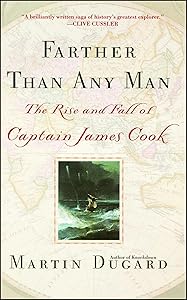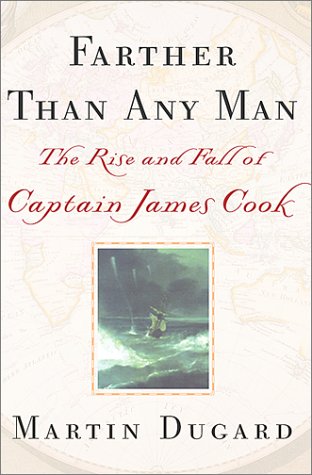
Farther Than Any Man: The Rise and Fall of Captain James Cook
Martin Dugard
From Publishers Weekly In a strong effort "to clear away the tangle of myth and hero-worship" that surrounds his subject, Dugard (Knockdown: The Harrowing True Account of a Yacht Race Turned Deadly), a well-known adventurer himself, deftly recounts the exciting story of James Cook, a farm boy from northern England who at first worked on merchant ships and then, when offered a chance to captain his own ship, turned his employer down and joined the Royal Navy. Cook started at the bottom and worked his way up, but knew he was not from the right social class to advance to captain. However, others recognized his talents: Cook was the first noncommissioned Royal Navy officer to be appointed to command a vessel. His trek with the Endeavour which began in 1768 and circumnavigated the globe, charted the coasts of New Zealand, scouted numerous Pacific isles and retrieved botanist Joseph Banks (who grew to respect Cook after trying to steal command of his ship) brought Cook international fame. Dugard recounts Cook's four-year voyage with the Resolution, which also sailed around the world while trying to locate the coasts of the legendary Southern Continent (Antarctica). By the end of this voyage, Dugard contends, Cook's ego had begun to get in the way of his talent. Thereafter, Cook began to make errors and became tyrannical at sea. This character change ultimately cost Cook his life when he was slain by Hawaiian natives. Well researched, with information from Cook's own journals, this fast-paced book brings to life the English explorer driven to outclass his predecessors and contemporaries. Copyright 2001 Cahners Business Information, Inc. From Library Journal Like Pizarro and Cortez, Capt. James Cook changed history by discovering unknown lands and opening them up to European settlement. Born to a farming family in 1729, Cook longed for a career at sea, apprenticed himself to a shipping company, and after nine years rose to the rank of captain in the merchant marine. On the verge of a profitable career, he resigned to enlist in the Royal Navy and soon became an officer an improbable feat in the 18th century. After service in Canada in the French and Indian War, he was given command of a survey ship and spent time charting eastern Canada. Later, he commanded three epic voyages to the South Pacific, in 1769, 1772, and 1776, discovering Tahiti, New Zealand, Tonga, New Caledonia, and many other islands. In 1779, he arrived at the Kona coast of the big island of Hawaii, where hostile natives killed, steamed, and ate him. There are few exemplary biographies of Cook, and Dugard has written a masterly one-volume account of the great explorer's life. It belongs in all public and academic libraries. Stanley L. Itkin, Hillside P.L., New Hyde Park, NY Copyright 2001 Reed Business Information, Inc.