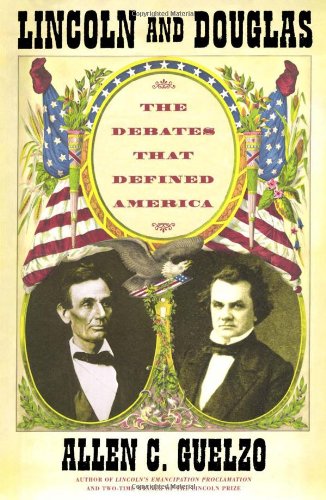
Lincoln and Douglas: The Debates that Defined America by Allen C. Guelzo

Lincoln and Douglas: The Debates that Defined America

Allen C. Guelzo
383 pages
Simon & Schuster
Feb 2008
Politics WSBN
3
Readers
1
Reviews
0
Discussions
0
Quotes
In 1858, Abraham Lincoln was known as a successful Illinois lawyer who had achieved some prominence in state politics as a leader in the new Republican Party. Two years later, he was elected president and was on his way to becoming the greatest chief executive in American history. <br> <br> What carried this one-term congressman from obscurity to fame was the campaign he mounted for the United States Senate against the country's most formidable politician, Stephen A. Douglas, in the summer and fall of 1858. Lincoln challenged Douglas directly in one of his greatest speeches -- &quot;A house divided against itself cannot stand&quot; -- and confronted Douglas on the questions of slavery and the inviolability of the Union in seven fierce debates. As this brilliant narrative by the prize-winning Lincoln scholar Allen Guelzo dramatizes, Lincoln would emerge a predominant national figure, the leader of his party, the man who would bear the burden of the national confrontation. <br> <br> Of course, the great issue between Lincoln and Douglas was slavery. Douglas was the champion of &quot;popular sovereignty,&quot; of letting states and territories decide for themselves whether to legalize slavery. Lincoln drew a moral line, arguing that slavery was a violation both of natural law and of the principles expressed in the Declaration of Independence. No majority could ever make slavery right, he argued. <br> <br> Lincoln lost that Senate race to Douglas, though he came close to toppling the &quot;Little Giant,&quot; whom almost everyone thought was unbeatable. Guelzo's Lincoln and Douglas brings alive their debates and this whole year of campaigns and underscores their centrality in the greatest conflict in American history. <br> <br> The encounters between Lincoln and Douglas engage a key question in American political life: What is democracy's purpose? Is it to satisfy the desires of the majority? Or is it to achieve a just and moral public order? These were the real questions in 1858 that led to the Civil War. They remain questions for Americans today.
Join the conversation

No discussions yet. Join BookLovers to start a discussion about this book!

When Talk Meant Something

The Lincoln-Douglas Debates in 1858 are largely remembered today because they brought an obscure Illinois lawyer and politician, Abraham Lincoln, to national prominence. Yet as this book demonstrates they also illuminate the confused and often contradictory U.S. attitudes towards slavery and race in the turbulent pre-Civil War years. The Republican Party of the 1850's was formed from the imploding Whig Party and disaffected members of the then Democratic Party around a common theme that slavery, the peculiar institution of the South should be contained within the bounds set by the Missouri Compromise of 1820. This not surprising in that the compromise was the work of Whig Henry Clay whose memory was still revered by many Whigs, including Lincoln. Under this compromise Missouri entered the U.S. as a slave state, but slavery would be excluded from all portions of the remainder of the Louisiana Purchase above latitude 36 30. Now the Republican Party including Lincoln made it clear repeatedly that they were not abolitionists. They did not want to abolish slavery where it already existed, but only to contain its expansion. They feared being overwhelmed in congress by slave holding states. Conversely, by the 1850's the slave holding states begin to fear that as the territory of purchase started to develop into states, they would be overwhelmed in the congress by non-slave states and slavery itself would be at risk. The Democratic Party of the time not exactly a pro-slavery party, but it was considerably less adamant than the republicans in wanting to contain the growth of slavery. It was seen by most as the party most sympathetic to the slave holding states of the south. Stephan A. Douglas arguably the most prominent member of the party hoped to maintain both party unity and to give the Democrats something like parity with burgeoning Republican Party. He therefore successfully overthrew the Missouri Compromise in favor of allowing each state to determine the status of ...

No quotes shared yet. Join BookLovers to share your favorite quotes!

Earn Points
Your voice matters. Every comment, review, and quote earns you reward points redeemable for Bitcoin.
Comment +5 pts Review +20 pts Quote +7 pts Upvote +1 pt
BookMatch Quiz
Find books similar to this one
About this book
Pages 383
Publisher Simon & Schuster
Published 2008
Readers 3