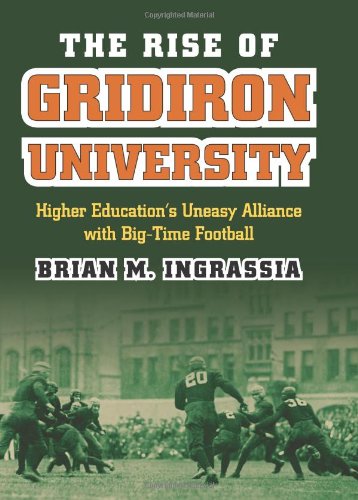
The Rise of Gridiron University: Higher Education's Uneasy Alliance with Big-Time Football by Brian M. Ingrassia

The Rise of Gridiron University: Higher Education's Uneasy Alliance with Big-Time Football

Brian M. Ingrassia
322 pages
University Press of Kansas
Mar 2012
Hardcover
Sports WSBN
3
Readers
1
Reviews
0
Discussions
0
Quotes
The quarterback sends his wide receiver deep. The crowd gasps as he launches the ball. And when he hits his man, the team's fans roar with approval - especially those with the deep pockets. Make no mistake; college football is big business, played with one eye on the score, the other on the bottom line. But was this always the case? <br><br>Brian M. Ingrassia here offers the most incisive account to date of the origins of college football, tracing the sport's evolution from a gentlemen's pastime to a multi-million dollar enterprise that made athletics a permanent fixture on our nation's campuses and cemented college football's place in American culture. He takes readers back to the late 1800s to tell how schools embraced the sport as a way to get the public interested in higher learning-and then how football's immediate popularity overwhelmed campuses and helped create the beast we know today. <br><br>Contrary to conventional wisdom, Ingrassia proves that the academy did not initially resist the inclusion of athletics; rather, progressive reformers and professors embraced football as a way to make the ivory tower less elitist. With its emphasis on disciplined teamwork and spectatorship, football was seen as a &quot;middlebrow&quot; way to make the university more accessible to the general public. What it really did was make athletics a permanent fixture on campus with its own set of professional experts, bureaucracies, and ostentatious cathedrals. <br><br>Ingrassia examines the early football programs at universities like Michigan, Stanford, Ohio State, and others, then puts those histories in the context of Progressive Era culture, including insights from coaches like Georgia Tech's John Heisman and Notre Dame's Knute Rockne. He describes how reforms emerged out of incidents such as Teddy Roosevelt's son being injured on the field and a section of grandstands collapsing at the University of Chicago. He also touches on some of the problems facing current day college football and shows us that we haven't come far from those initial arguments more than a century ago. <br><br><i>The Rise of Gridiron University</i> shows us where and how it all began, highlighting college football's essential role in shaping the modern university-and by extension American intellectual culture. It should have wide appeal among students of American studies and sports history, as well as fans of college football curious to learn how their game became a cultural force in a matter of a few decades.
Join the conversation

No discussions yet. Join BookLovers to start a discussion about this book!

A Consumer Blitz Sacks Elite Institutions

Early last week, I finished reading "The Rise of Gridiron University: Higher Education's Uneasy Alliance with Big-Time Football" by Brian M. Ingrassia. I really enjoyed this book: It is, however, more intellectual and cultural history than a gridiron narrative of distinction. And is much more academically erudite than relaxed beach perusing. Ingrassia illuminates the paradox between higher education's scholarly mission to harvest knowledge and produce civic leaders and a consumer-driven capitalistic culture that yielded much-needed revenue for large institutions. While the Western Frontier closed during the Gilded Age, progressive and reform-minded Americans fancied a new definition of manhood in an industrial society, growing in urban communities with an influx of immigrants. Numerous intellectuals embraced Social Darwinism as an ideological anchor for their focus on improving young American men: And according to several campus kingpins, the gridiron provided the perfect training ground for athletic prowess and competitiveness. Coaches quickly promoted their impact on constructing young boys into men and wrote (and sold) books to cement importance of discipline and athletic training. As revenue rolled into athletic departments, football gurus became highly paid professionals and national celebrities. On some campuses, the pigskin programs became sovereign islands of power and cultural influence as massive stadiums were built to sell tickets to a demanding public willing to spend their hard-earned currency on tickets. Several campus leaders thought that football provided a bridge--and marketing tool--between the elite professors and upper-class students who lived in isolated campus estates and the general public in the surrounding communities. Of course, dissenting professors opposed the autonomous athletic branches and its new celebrity coaches as well as the influence and corruption of cash on campus. However, the dissenters could not overcome the avalanche of ...

No quotes shared yet. Join BookLovers to share your favorite quotes!

Earn Points
Your voice matters. Every comment, review, and quote earns you reward points redeemable for Bitcoin.
Comment +5 pts Review +20 pts Quote +7 pts Upvote +1 pt
BookMatch Quiz
Find books similar to this one
About this book
Pages 322
Publisher University Press of...
Published 2012
Readers 3