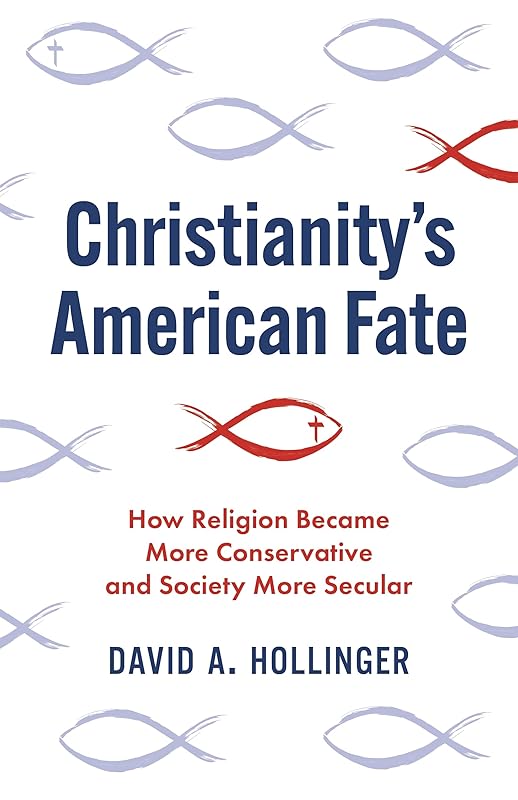
Christianity's American Fate: How Religion Became More Conservative and Society More Secular by David A. Hollinger

Christianity's American Fate: How Religion Became More Conservative and Society More Secular

David A. Hollinger
216 pages
Princeton University Press
Oct 2022
Hardcover
Christian Books WSBN
0
Readers
0
Reviews
0
Discussions
0
Quotes
Tracing the rise of evangelicalism and the decline of mainline Protestantism in American religious and cultural life. How did American Christianity become synonymous with conservative white evangelicalism? This sweeping work by a leading historian of modern America traces the rise of the evangelical movement and the decline of mainline Protestantism's influence on American life. In Christianity's American Fate, David Hollinger shows how the Protestant establishment, adopting progressive ideas about race, gender, sexuality, empire, and divinity, liberalized too quickly for some and not quickly enough for others. After 1960, mainline Protestantism lost members from both camps -- conservatives to evangelicalism and progressives to secular activism. A Protestant evangelicalism that was comfortable with patriarchy and white supremacy soon became the country's dominant Christian cultural force.. Hollinger explains the origins of what he calls Protestantism's "two-party system" in the United States, finding its roots in America's religious culture of dissent, as established by seventeenth-century colonists who broke away from Europe's religious traditions; the constitutional separation of church and state, which enabled religious diversity; and the constant influx of immigrants, who found solidarity in churches. Hollinger argues that the United States became not only overwhelmingly Protestant but Protestant on steroids. By the 1960s, Jews and other non-Christians had diversified the nation ethnoreligiously, inspiring more inclusive notions of community. But by embracing a socially diverse and scientifically engaged modernity, Hollinger tells us, ecumenical Protestants also set the terms by which evangelicals became reactionary.
Join the conversation

No discussions yet. Join BookLovers to start a discussion about this book!

No reviews yet. Join BookLovers to write the first review!

No quotes shared yet. Join BookLovers to share your favorite quotes!

Earn Points
Your voice matters. Every comment, review, and quote earns you reward points redeemable for Bitcoin.
Comment +5 pts Review +20 pts Quote +7 pts Upvote +1 pt
BookMatch Quiz
Find books similar to this one
About this book
Pages 216
Publisher Princeton University...
Published 2022
Readers 0