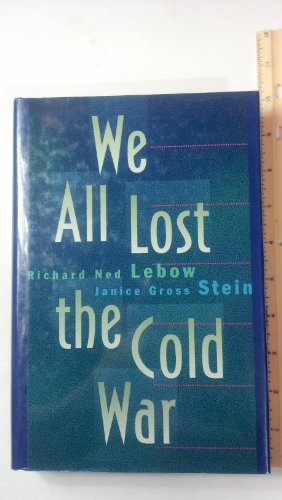
We All Lost the Cold War (Princeton Studies in International History and Politics) by Richard Ned Lebow

We All Lost the Cold War (Princeton Studies in International History and Politics)

Richard Ned Lebow
560 pages
Princeton University Press
Apr 1994
Hardcover
Politics WSBN
1
Readers
0
Reviews
0
Discussions
0
Quotes
From Publishers Weekly In their study of the 1962 Cuban missile crisis and the 1973 confrontation between the U.S. and the U.S.S.R. during the Arab-Israeli war, the authors refute the popular notion that the U.S. policy of nuclear deterrence prevented war between the superpowers in both crises and convinced the Soviet leadership that this country would not tolerate aggression. Lebow and Stein reconstruct the calculations of the leaders on both sides to show that the U.S.'s threat-based deterrence strategy was more provocative than restraining in 1962, that it was irrelevant in '73 and that Washington's faith in the efficacy of showdown diplomacy actually prolonged the Cold War. In this significant addition to the literature of international crisis management, the authors urge greater appreciation of the risks of threat-based strategies and greater attention to the mutual clarification of interests. They suggest that these lessons be applied to the prevention, management and resolution of conflict in the post-Cold War era. Lebow is a professor of political science at the University of Pittsburgh; Stein is a professor of political science at the University of Toronto. Copyright 1993 Reed Business Information, Inc. From Kirkus Reviews In a well-articulated, arresting argument, Lebow (Political Science/Pittsburgh) and Stein (Political Science/Toronto) assert that the conventional wisdom that the West won the cold war is mistaken, and that military spending and geopolitical rivalry have exhausted the US and the countries of the former USSR, with implications that continue to haunt us today. Lebow and Stein make their case by examining two crises of the cold war: the 1962 Cuban missile crisis and 1973 the Arab-Israeli War. In both cases, the authors persuasively argue, the crisis was caused by politicians playing the game of ``deterrence.'' In Cuba, the American threat to use nuclear weapons was an escalation of the crisis; once the superpowers confronted each other, they needed to compromise in order to resolve the impasse (the problem was resolved when both governments agreed to remove missiles). In 1973, the US tried to prevent the Soviet Union from intervening in the Arab-Israeli War by alerting its strategic and conventional forces worldwide. Here, the crisis was resolved when the Soviet Union declined to respond to the alert. The authors argue, based on newly available evidence, that far from deterring the Soviet Union, the US worldwide alert actually might have escalated the crisis; the Soviet Union never had any intention of actually intervening, and a large group in the Kremlin argued that the it should respond by alerting its own forces. After examining how compromise and moderation resolved crises caused by deterrence theorists, Lebow and Stein contend that the nuclear arms race, far from preventing WW III, actually exacerbated superpower tensions and review evidence that Reagan's expansion of defense spending after 1981 delayed rather than accelerated the process of reform in the Soviet Union, which occurred for reasons largely unrelated to the superpower rivalry, and wasted resources urgently needed for domestic purposes. The authors conclude that deterrence prolonged rather than ended the cold war. An intelligent and provocative examination of the legacy of the cold war. --
Join the conversation

No discussions yet. Join BookLovers to start a discussion about this book!

No reviews yet. Join BookLovers to write the first review!

No quotes shared yet. Join BookLovers to share your favorite quotes!

Earn Points
Your voice matters. Every comment, review, and quote earns you reward points redeemable for Bitcoin.
Comment +5 pts Review +20 pts Quote +7 pts Upvote +1 pt
BookMatch Quiz
Find books similar to this one
About this book
Pages 560
Publisher Princeton University...
Published 1994
Readers 1