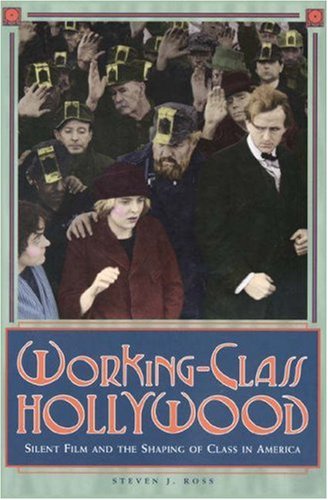
From Library Journal Ross (history, Univ. of Southern California) offers a thought-provoking examination of silent film and its social reverberations. This medium provided the earliest, cheapest, and most far-reaching form of entertainment to capture the public, frequently portraying working-class life with truth and empathy. These productions made definite statements about labor and politics while vigorously defining class issues and struggles?a potent combination during any era. The resulting government and corporate disdain created pressure, but the vast potential for profit was quickly perceived as well. Soon, the studio system took hold with its far softer approach to content. This work abounds in solid information on films, events, trends, historical details, and people along with intelligent analyses of the changing perceptions of class that were partially shaped by these early cinematic ventures. Essential for scholars and serious students of film and American culture.?Carol J. Binkowski, Bloomfield, Copyright 1997 Reed Business Information, Inc. From Kirkus Reviews An impassioned celebration of a movement that depicted social issues at the birth of the big screen. In this century's first three decades, filmmakers could ``entertain, educate, and politicize millions of Americans'' in silent movies, according to Ross (History/Univ. of Southern Calif.). From the days of the earliest nickelodeons, film was the most egalitarian of industries. A largely immigrant, working-class audience, attending one of the few types of entertainment they could afford, saw their lives reflected sympathetically on the screen by Charlie Chaplin, Upton Sinclair, and D.W. Griffith (whose working-class sympathies in early films were as pronounced as the appalling racism he demonstrated in Birth of a Nation). Moreover, start-up costs were low enough to entice newcomers of all ideological stripes to the field. Among these latter were individual workers, unions, and radicals who came to see film as a medium with revolutionary potential for shaping mass views of what it meant to be a worker. Although comparatively few in number, these leftist filmmakers were considered dangerous enough that J. Edgar Hoover assigned secret agents to spy on them. With the rise of the Hollywood studio system in the 1920s, the worker-film movement collapsed, undone by rising costs, inability to secure financing from Wall Street or large union groups such as the AFL, and censorship. Ross draws on labor newspapers, union records, and government documents, as well as more conventional film-studies materials to limn this obscure corner of early cinema. But he occasionally lapses into academese (e.g., ``gendered space''), and never proves the centrality of film in shaping notions of class. Moreover, he criticizes conservative films for stereotypes while never hinting that some radical cinema might have failed because it was more agitprop than entertainment. A valuable addition to cinema history, though marred by leftist sympathies that seldom allow for subtle analysis. (28 pages b&w illustrations) --