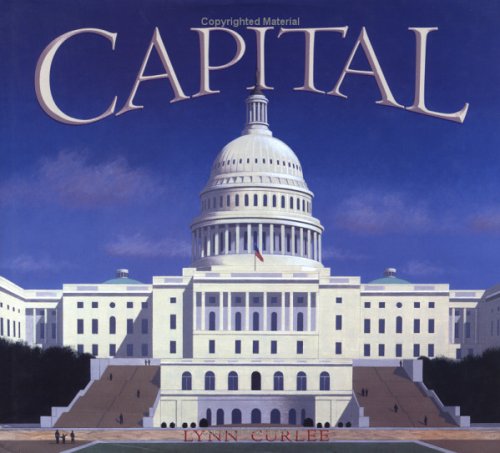
Capital
Lynn Curlee
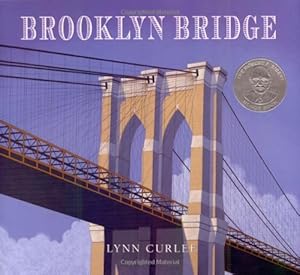
From Publishers Weekly This illuminating history of Washington, D.C., spotlights five of the city's most imposing structures: the U.S. Capitol, the White House, the Washington Monument, the Lincoln Memorial and the Jefferson Memorial. After explaining how George Washington selected the site of the new government seat, the author describes the original plan for the city, developed by engineer and architect Pierre-Charles L'Enfant, who "vowed to create a capital `magnificent enough to grace a great nation.' " Unlike his Brooklyn Bridge and Liberty, which focused on the development of one structure, Curlee here chronicles the planning and construction of all five landmarks, emphasizing the historical and architectural significance of each. He covers a lot of territory; some readers may wish he had dedicated the entire book to the most complex and captivating story (and the one to which he devotes the most pages): the Capitol. Curlee's paintings of the designs and buildings, especially the Capitol's dome, seemingly thrusting through the clouds, are as breathtaking as ever; the portraits of people, however, tend to be somewhat static or wooden. Budding historians will be most captivated by the tale of the Capitol's construction, its burning by the British during the War of 1812, its rebuilding and subsequent enlargements, as well as an ample sprinkling of trivia (e.g., Thomas Jefferson's anonymously submitted plans for the original "President's House" did not win its design competition; the Capitol served as a hospital during the Civil War; etc.). Curlee makes dramatic use of light in his spare, realistic acrylic paintings of this monumental architecture, readily conveying the buildings' splendor and grace. All ages. Copyright 2002 Reed Business Information, Inc. From School Library Journal Grade 3-5-This in-depth look at the planning and construction of some of our country's most treasured architecture, which lines the National Mall in Washington, DC, is also U.S. history encapsulated. Mandated by the Constitution in 1787, the capital has existed as a potent symbol, both architectural and political, of a city and a government that belong to the entire country. At every architectural turn in the next two centuries, the building that has taken place around the Mall has echoed and amplified national events and concerns, and Curlee makes these connections clear. His training in art history is evident in his analyses of not only the buildings themselves, but also their role as expressions of our democratic beliefs. His oil paintings, which support the text admirably, are beautiful and architectural, almost severe, but often have human figures included both for scale and emotional accessibility, and in this they echo the text. This title is a worthy companion to Curlee's Liberty (2000), Rushmore (1999), and Brooklyn Bridge (2001, all Atheneum). It is a stirring, timely, and thoughtful reminder of the principles underpinning the creation of our nation, and a necessary addition to American history collections.