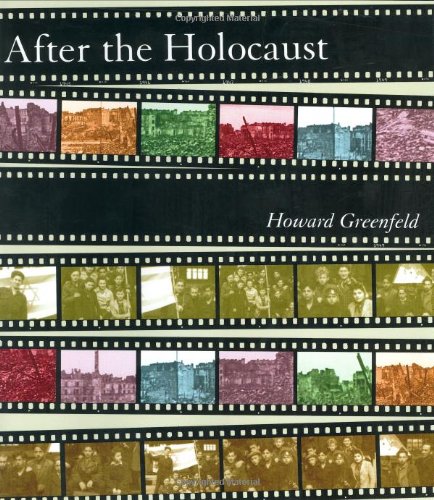

After the Holocaust by Howard Greenfeld

After the Holocaust

Howard Greenfeld
160 pages
Greenwillow Books
Oct 2001
Hardcover
History WSBN
0
Readers
0
Reviews
0
Discussions
0
Quotes
From Publishers Weekly Striking cover art and abundant photographs will help attract readers to this grim and not wholly successful work. Greenfeld (The Hidden Children) contends that little attention has been paid to the vast difficulties facing young Jewish survivors of the Holocaust. To fill that stated void, he focuses on eight adults, mostly from Eastern Europe but all currently living in the U.S., who relate their postwar experiences in their own words. Their stories prove gripping and the author effectively demonstrates the complexity of postwar conditions. However, the premise is not entirely accurate: many Holocaust memoirs lengthily and sensitively discuss how survivors overcame extreme obstacles, from anti-Semitism in their native lands to hardships in displaced-persons camps to domestic upheavals in partially reunited families. (The books of Aranka Siegal, Anita Lobel, Ruth Minsky Sender, Johanna Reiss and Rene Roth-Hano, among others, come to mind; but the bibliography here refers readers instead to general nonfiction mostly written for adults.) Greenfeld also breaks up his interviewees' narratives, presenting segments from each person's experience in four sections (e.g., "Liberation," "After the Liberation: The Search"); the structure makes it difficult to keep all eight individuals straight and also creates or allows for gaps (Why does a Zionist group prevent a Jewish mother, also a survivor, from taking custody of her 12-year-old daughter?). While this work falls short of the overview it seems to promise, it provides fresh awareness of the Holocaust and the war. Ages 12-up. Copyright 2001 Cahners Business Information, Inc. From School Library Journal Gr 7 Up-Eight Jewish survivors (five women, three men) share their personal experiences of what happened after the defeat of Hitler. Each of the oral histories is delivered in three parts, under separate sections in the book: "Liberation," "After the Liberation," and "The DP Camps." (The time spent in the displaced persons facilities, organized by the Allies and often housed in former concentration camps and Nazi bunkers, provided the victims with shelter and allowed them to begin to piece together their lives and come to terms with what they had been through.) The organization of this title differs from many related books such as Elaine Landau's Holocaust Memories (Watts, 2001) in that all of these different and very affecting stories are offered in chronological segments. While this places readers in the position of having to keep everyone straight, it also facilitates the comparing and contrasting of the various speakers' experiences. Greenfeld provides extensive amounts of historical information (some featured in sidebars) that support these first-person oral testimonies and puts them into the context of youth being released from years of imprisonment into an uncertain future. What the future held (immigration to the U.S. in all these cases) is briefly but neatly wrapped up in the afterword, completing this important and relevant piece of history. Captioned black-and-white archival photos are found throughout.
Join the conversation

No discussions yet. Join BookLovers to start a discussion about this book!

No reviews yet. Join BookLovers to write the first review!

No quotes shared yet. Join BookLovers to share your favorite quotes!

Earn Points
Your voice matters. Every comment, review, and quote earns you reward points redeemable for Bitcoin.
Comment +5 pts Review +20 pts Quote +7 pts Upvote +1 pt
BookMatch Quiz
Find books similar to this one
About this book
Pages 160
Publisher Greenwillow Books
Published 2001
Readers 0