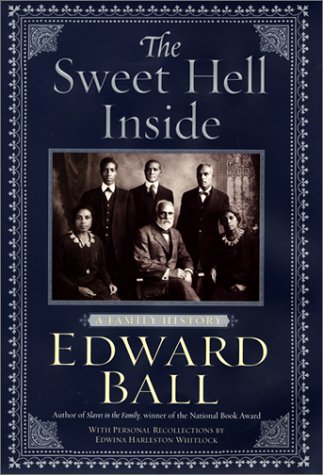
The Sweet Hell Inside: A Family History by Edward Ball

The Sweet Hell Inside: A Family History

Edward Ball
400 pages
William Morrow
Oct 2001
Hardcover
History WSBN
0
Readers
0
Reviews
0
Discussions
0
Quotes
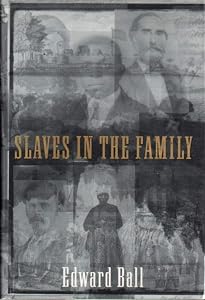
From Publishers Weekly In researching the bestseller Slaves in the Family (1998), Ball encountered William Harleston (1804-1874), a white man whose family considered him a bachelor though he lived for 25 years with Kate Wilson, his former slave, on and around the South Carolina rice plantation where he was born. They had eight children (born between 1843 and 1867) whose family history is recounted here largely via the memories of Edwina Harleston Whitlock (b. 1916), Ball's previously unknown relation, who referenced the "little red book" and "snippets of letters, handwritten copies of wills and genealogical charts" passed on to her by an uncle. Covering nearly 200 years, Ball's book tells "a tale of black and white sex in America, and its latter-day harvest," distinguished by remarkable family accomplishments and sprinkled with diverting scandal. By 19th-century standards, William and Kate's sons were educated professionals (butler, housepainter, tailor); their daughters married well. Their son Edwin's undertaking business brought wealth and status, affording the next generation a good education and the means to pursue the arts, teaching and social work. More fame arrived when Edwin's daughter married Daniel Joseph Jenkins, "a dark minister who was born a slave," who became founder of the orphanage in Charleston that spawned the Jenkins Orphanage Band, a force in the development of jazz. Ball's somewhat uneven work often digresses into such subjects as the history of jazz, the Harlem Renaissance and even embalming. A genealogical chart would have benefited readers, and scholars will find the notes a thorny grab bag. But Ball's mosaic illuminates the Harlestons' "little-known but fascinating role in the American national saga." More than 60 photos not seen by PW. (Oct.)Forecast: Given the attention paid Ball's previous book and the currency of his subject, especially following the Jefferson-Hemings story, this one should attract strong attention and approach the sales of its predecessor.Copyright 2001 Cahners Business Information, Inc. From Library Journal Ball, who won the National Book Award for Slaves in the Family, returns to his Southern roots to find the Harlestons, part of the small "colored elite" of Charleston, and tell their story from the 1840s through 2000. It is a remarkable journey, with Ball tracking the family and their connections from the racially and culturally cloistered South Carolina to London, Paris, New York, Chicago, and many other stops. Family members won fame and modest if sometimes fleeting fortunes as undertakers, ministers, musicians, artists, and more. Especially significant was the Jenkins Orphanage Band, which escaped Charleston in high-stepping style and became an early forebear of ragtime and jazz. Ball sometimes overplays his sources in speculating on motives and relationships. But his background excursions into black urban life and economy and his accounts of musicians, intellectuals, and artists struggling to find their way among black and white make real the hidden world(s) of an "in-between class" too long in the shadows of history and memory.
Join the conversation

No discussions yet. Join BookLovers to start a discussion about this book!

No reviews yet. Join BookLovers to write the first review!

No quotes shared yet. Join BookLovers to share your favorite quotes!

Earn Points
Your voice matters. Every comment, review, and quote earns you reward points redeemable for Bitcoin.
Comment +5 pts Review +20 pts Quote +7 pts Upvote +1 pt
BookMatch Quiz
Find books similar to this one
About this book
Pages 400
Publisher William Morrow
Published 2001
Readers 0