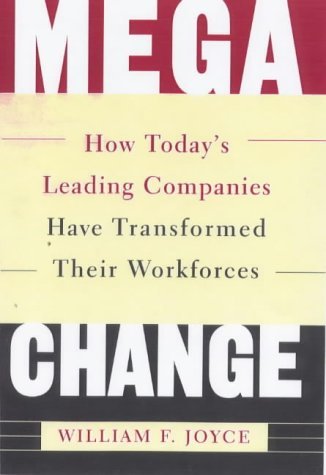
MEGACHANGE: How Today's Leading Companies Have Transformed Their Workforces by William F. Joyce

MEGACHANGE: How Today's Leading Companies Have Transformed Their Workforces

William F. Joyce
256 pages
Free Press
Jul 1999
Hardcover
Business & Investing WSBN
0
Readers
0
Reviews
0
Discussions
0
Quotes
In the last decade, organizations of every type -- from the largest transnational corporations to local neighborhood nonprofits -- have spent billions of dollars attempting to improve productivity and efficiency. But while 85 percent of U.S.-based corporations engaged in some type of restructuring between 1990 and 1995, most of these changes were not successful. Indeed, 60 percent reported not having achieved their goals, and 44 percent said things had actually gotten worse. Almost 70 percent attempted to restructure again within a year. Sadly, despite this enormous waste, the vast majority of companies remains wedded to archaic management methods and practices that bury creativity under a mind-numbing avalanche of pointless bureaucratic systems and procedures that deny their employees' need for satisfying work. The problem, explains William F. Joyce, is that these traditional methods and practices are based on an assumption of human limitations -- rather than human capability -- and thus are "flawed in a most fundamental way." In his radical reassessment of management practices, Joyce explains that, in order to succeed in the future, business needs to make a complete turnaround in its approach to employees: Instead of making human fallibility and lack of potential the foundation of organizational structure, management must begin from an assumption of human capability and talent. Joyce's "New logic for Change" is composed of four critical steps: Empowering the Workforce, Engaging Systems, Reforming Structures, and Remaking Strategy. Conceived and developed while the author was guiding-large-scale change at Nabisco, Citibank, and Aetna (during its acquisition of U.S. Healthcare) , the MegaChange system creates an organizational culture that emphasizes not just human value, but human values, and is based on the importance -- both for the individual employee and for the organization as a whole -- of meaningful work.
Join the conversation

No discussions yet. Join BookLovers to start a discussion about this book!

No reviews yet. Join BookLovers to write the first review!

No quotes shared yet. Join BookLovers to share your favorite quotes!

Earn Points
Your voice matters. Every comment, review, and quote earns you reward points redeemable for Bitcoin.
Comment +5 pts Review +20 pts Quote +7 pts Upvote +1 pt
BookMatch Quiz
Find books similar to this one
About this book
Pages 256
Publisher Free Press
Published 1999
Readers 0