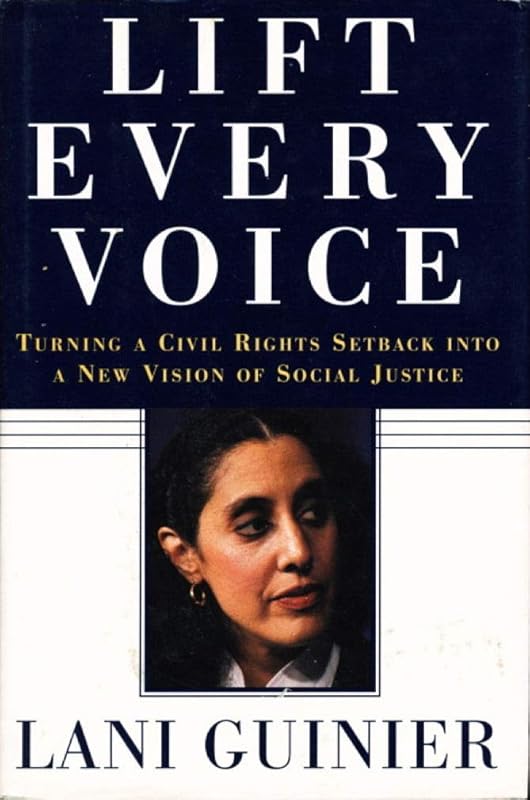
Lift Every Voice: Turning a Civil Rights Setback Into a New Vision of Social Justice
Lani Guinier
The former nominee for assistant attorney general for civil rights discusses, for the first time, how President Clinton abandoned his ambitious civil rights agenda when the political right attacked her nomination, and how the civil rights movement has subsequently suffered. 50,000 first printing. Tour. Read more Continue reading Read less AMAZON.COM REVIEW
When Bill Clinton nominated University of Pennsylvania Law School Professor Lani Guinier to the position of Assistant Attorney General for Civil Rights in 1993, she was immediately beset upon by right-wing critics of the president. Taking her writings on cumulative and proportional voting out of context, they branded her a "quota queen." Guinier, on instructions from administration officials, made almost no effort to defend herself against this public smearing of her work and reputation. Then, to her surprise, Clinton himself withdrew her nomination, stating in a press conference that her views were "undemocratic."The Tyranny of the Majority reprinted the articles that were the source of this controversy. Now, in Lift Every Voice, Professor Guinier explains the principles underlying those writings in layman's terms and offers her personal perspective on what happened in the spring and summer of 1993, taking us behind the scenes to meetings with Clinton, Attorney General Janet Reno, and other Washington officials. But perhaps more importantly, she writes about how, after she was cut loose by an intimidated White House, she regained her confidence in the civil rights movement. Recalling the activism of ordinary people like her father and the clients she represented as a lawyer for the NAACP Legal Defense Fund, Guinier reminds us that a better society cannot be built by governmental edict alone, but requires commitment on the part of the citizenry. A recent book on mathematics, K.C. Cole's The Universe and the Teacup, vindicated Guinier's theories on proportional representation at the statistical level. The debate sparked by Lift Every Voice may, in the long run, end up vindicating her at the political level as well.
FROM LIBRARY JOURNAL
Guinier on why she lost the nomination for assistant attorney general.
Copyright 1997 Reed Business Information, Inc. FROM BOOKLIST
The more things change . . . In 1997, the Senate Judiciary Committee refused to send the nomination of Bill Lann Lee as assistant attorney general for civil rights to the floor for a vote; four years earlier, Guinier's nomination for the same post was withdrawn by the White House in the face of a similar attack from the Right distorting the University of Pennsylvania law professor's views (plus the reluctance of the Democratic-controlled judiciary panel to hold a hearing) . Lift Every Voice tells a number of stories. In the section titled "Trials," Guinier offers recollections of the several months in 1993 when she was a lightning rod, portrayed as a "quota queen" by foes and theoretically dispassionate observers who did not bother to read the articles used to discredit her; in "Bridges," she surveys civil rights history and the litigation and legislative work that affected the evolution of her concepts; and in "Hearings," she explains those ideas as ways of "breathing new life into American democracy." Guinier criticizes the Clinton administration's handling of her nomination but avoids whining; painful experience leads her to challenge the insider approach of major civil rights organizations as well as politicians. In the end, Guinier defines democracy and citizenship more broadly than her enemies (and some of her friends) ; those definitions deserve serious debate. Mary Carroll FROM KIRKUS REVIEWS
Legal scholar Guinier describes the experience that made her famous and the lessons she learned from it: President Clinton's withdrawal in 1993 of her nomination as assistant attorney general for civil rights, under withering attack from conservatives. Guinier, recently appointed Harvard Law School's first tenured black female professor, insists in this half-autobiography, half-treatise that Clinton actually did her a favor, despite her anger over the way she was treated by hostile critics, a press too lazy to verify attacks levied against her, and a president who had once been her friend. ``From a momentary crisis,'' she writes, ``I retrieved the opportunity to become who I am'': someone who now strives to emulate Martin Luther King Jr. and Nelson Mandela by ``pushing forward from behind.'' Guinier describes how she has relearned lessons from early in her career as a crusading lawyer for the Legal Defense Fund of the NAACP, that lasting social change comes from the bottom up, from an energized citizenry, rather than from top-down fiats from legislators or administration bureaucrats. Guinier repeatedly hits readers over the head with lectures on participatory democracy and building from the grassroots. Also, her narrative would make more sense if she had placed her most important chapter at the beginning rather than near the end. In it, she defends her belief in proportional representation, which so outraged right-wing pundits in 1993. Her arguments for systems in which, basically, representation is based on the percentage of votes received, rather than winner-take-all, seem perfectly sensible. Certainly, just as her outnumbered defenders argued in 1993, there is nothing in her theories, which are modeled after numerous current and historical examples, to justify the vilification she received. Despite her tendency to pedantry, Guinier is an original and stimulating thinker whose ideas, in contrast to her last wide exposure to the public eye, may now get the broader and fairer airing they deserve. -- Copyright 1998, Kirkus Associates, LP. All rights reserved. REVIEW
A veteran civil-rights attorney and legal theorist, Guinier was nominated for the position of Assistant Attorney General for Civil Rights on April