ALA Guide to Information Access by American Library Association

ALA Guide to Information Access

American Library Association
533 pages
Random House Reference
Aug 1994
Hardcover
All Non-Fiction WSBN
0
Readers
0
Reviews
0
Discussions
0
Quotes
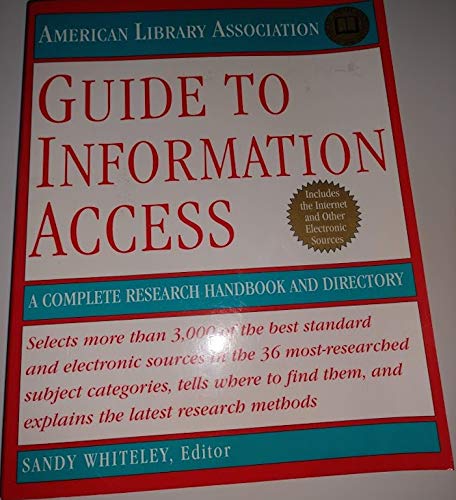
The American Library Association Guide to Information Access is the most comprehensive, up-to-date, and easy-to-use tool for researching facts and topics. It provides not only a thorough coverage of the print sources but also of the electronic sources that have revolutionized the research field. It is, in fact, the first major research guidebook to do so.Whether the researcher is a student, educator, legal or medical professional, financial or marketing executive, journalist, hobbyist, scholar, writer, or just someone trying to find out more about an area of special interest, this book is the place to start.The traditional research sources - libraries, archives, newspapers, government publications, and government agencies - are examined in detail, as are all the methods of accessing them, from the printed word to electronic databases.The book guides the reader through a virtual minicourse in electronic research sources, from the OPACs (online public access catalogs) and other online services available at most public libraries to those available by subscription on home or workplace computers. These include specialized databases such as Lexis (for lawyers) and Medis (for physicians and medical scientists) , as well as more general information exchanges such as the Internet - the international network serving at least thirty million people in more than fifty countries. Also covered are CD-ROM (Compact Disc - Read-Only Memory) sources of data, many of which are available in more than eighty percent of all libraries. They can also be purchased for use on home or workplace computers with a CD-ROM drive.The heart of the American Library Association Guide to Information Access, however, is its extensive compilation of the basic sources for the thirty-six most frequently researched areas. Each topic chapter starts with a list of books that provide a general introduction to the subject; a guide to the literature lists other reference books as well as special sources such as periodicals and library collections. This is followed by the current electronic sources, both online and CD-ROM. Finally, the traditional sources are enumerated: periodicals, government documents, government agencies, associations, and special-interest libraries.The American Library Association Guide to Information Access will enable any reader to readily locate and access both the print and electronic research sources in virtually any field.
Join the conversation

No discussions yet. Join BookLovers to start a discussion about this book!

No reviews yet. Join BookLovers to write the first review!

No quotes shared yet. Join BookLovers to share your favorite quotes!

Earn Points
Your voice matters. Every comment, review, and quote earns you reward points redeemable for Bitcoin.
Comment +5 pts Review +20 pts Quote +7 pts Upvote +1 pt
BookMatch Quiz
Find books similar to this one
About this book
Pages 533
Publisher Random House Referen...
Published 1994
Readers 0