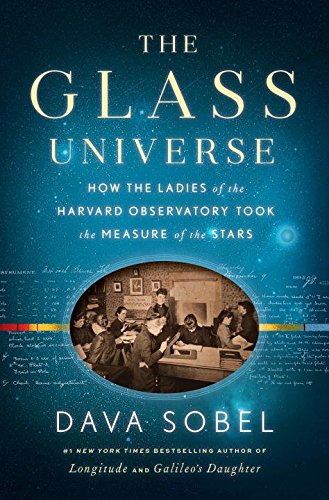
The Glass Universe: How the Ladies of the Harvard Observatory Took the Measure of the Stars by Dava Sobel

The Glass Universe: How the Ladies of the Harvard Observatory Took the Measure of the Stars

Dava Sobel
336 pages
Viking
Dec 2016
History WSBN
5
Readers
1
Reviews
0
Discussions
0
Quotes

Free account. We’ll keep this book ready while you join.

Find a copy

Formats and availability vary by store. As an Amazon Associate I earn from qualifying purchases.

<b>#1 <i>New York Times</i> bestselling author Dava Sobel returns with the captivating, little-known true story of a group of women whose remarkable contributions to the burgeoning field of astronomy forever changed our understanding of the stars and our place in the universe</b><br> <br> In the mid-nineteenth century, the Harvard College Observatory began employing women as calculators, or &quot;human computers,&quot; to interpret the observations made via telescope by their male counterparts each night. At the outset this group included the wives, sisters, and daughters of the resident astronomers, but by the 1880s the female corps included graduates of the new women's colleges - Vassar, Wellesley, and Smith. As photography transformed the practice of astronomy, the ladies turned to studying the stars captured nightly on glass photographic plates. The &quot;glass universe&quot; of half a million plates that Harvard amassed in this period - thanks in part to the early financial support of another woman, Mrs. Anna Draper, whose late husband pioneered the technique of stellar photography - enabled the women to make extraordinary discoveries that attracted worldwide acclaim. They helped discern what stars were made of, divided the stars into meaningful categories for further research, and found a way to measure distances across space by starlight. Their ranks included Williamina Fleming, a Scottish woman originally hired as a maid who went on to identify ten novae and more than three hundred variable stars, Annie Jump Cannon, who designed a stellar classification system that was adopted by astronomers the world over and is still in use, and Dr. Cecilia Helena Payne-Gaposchkin, who in 1956 became the first ever woman professor of astronomy at Harvard - and Harvard's first female department chair. Elegantly written and enriched by excerpts from letters, diaries, and memoirs, <i>The Glass Universe</i> is the hidden history of a group of remarkable women who, through their hard work and groundbreaking discoveries, disproved the commonly held belief that the gentler sex had little to contribute to human knowledge.
Join the conversation

No discussions yet. Join BookLovers to start a discussion about this book!

A great read, an important part of science history. Highly recommended.

I've been teaching general education astronomy classes for several years and had brought up the Harvard "Calculators" in lecture, so I was eager to get a more in-depth understanding of that era in astronomy. I had expected to read about how poorly the women were treated, kept from telescope work and relegated to menial tasks of looking at photographic plates, etc. Instead, we see strong and brilliant women changing the course of astronomy by their hard work, scientific acumen and strokes of genius. The expected resistance to women in leadership roles is there, to be sure, but not so much within the Harvard observatory community as from the university higher-ups. Several of these "calculator" women were internationally recognized as leaders in the field. Even the wealthy benefactors (such as Henry Draper's widow, Anna Draper), who helped the observatory's work to greatly expand, were women. Whether you're specifically interested in the subject of women in science or not, this book is just a great snapshot of science history, period. From the late 1800's, when next to nothing was known about what stars were made of, their lifecycle, whether there were other galaxies or not, etc., to the work of Edwin Hubble in the 1920's and 30's, with the discovery of an expanding universe populated by untold numbers of galaxies, a scientific road runs through the work of the ladies of the Harvard Observatory. The "big names" (like Hubble, Hertzsprung, Russell) were indebted to their work. In short, another great book from Dava Sobel. Previous books (Longitude and Galileo's Daughter) are also well worth reading. She is thorough but never plodding in her retelling of history. It feels alive, moving at times, and always interesting. Read more

No quotes shared yet. Join BookLovers to share your favorite quotes!

Earn Points
Your voice matters. Every comment, review, and quote earns you reward points redeemable for Bitcoin.
Comment +5 pts Review +20 pts Quote +7 pts Upvote +1 pt
Similar Books
Find books similar to this one
About this book
Pages 336
Publisher Viking
Published 2016
Readers 5