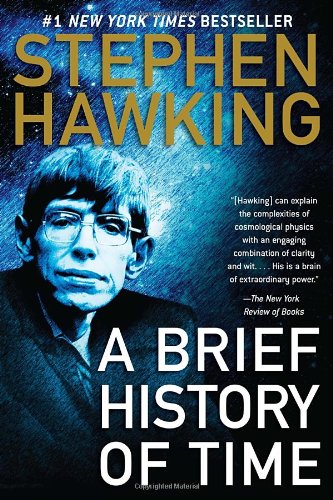
#1 NEW YORK TIMES BESTSELLERA landmark volume in science writing by one of the great minds of our time, Stephen Hawking’s book explores such profound questions as: How did the universe begin—and what made its start possible? Does time always flow forward? Is the universe unending—or are there boundaries? Are there other dimensions in space? What will happen when it all ends?Told in language we all can understand, A Brief History of Time plunges into the exotic realms of black holes and quarks, of antimatter and “arrows of time,” of the big bang and a bigger God—where the possibilities are wondrous and unexpected. With exciting images and profound imagination, Stephen Hawking brings us closer to the ultimate secrets at the very heart of creation.
No discussions yet. Join BookLovers to start a discussion about this book!
I truly recommend this book to high school students.
A Brief History of Time by Stephen Hawking is about modern physics for general readers. Its aim is not just listing some topics, but introducing modern physics by examining current scientific answers, although not complete, to fundamental questions like: Where did we come from? Why is the universe the way it is? Was there the beginning of time? Is there an ultimate theory that can explain everything? We don't have such a theory yet. I have read the first edition when I was a high school student around 1990, and this book is the revised version (revised in 1998). Compared to the first version, there are little changes. But there is one noticeable change in his point of view on the ultimate theory. According to him, recent findings on "dualities" seem to indicate that it would not be able to express an ultimate theory in a single fundamental formation. Instead, we may have to apply different theories to different situations, but in the areas which they overlap, they must coincide. The book has a lot of merits. Firstly, non-native English users including myself would feel comfortable and find it easy to read. He doesn't use difficult words and his writing style is clear. In the sense, he is better than other English scientific authors like R. Penrose, J. Gleick and I. Stewart. Secondly, the level of the book is well-chosen for general readers and the total page number is just less than 200 pages. If they read the book, at least, they would be able to learn more about how the universe began, how the stars have been formed, and how we have come here as the result of the evolution of the universe. More than that, the book contains interesting stories of some Nobel Prize winners in physics with their results related to the mentioned fundamental questions. This will help readers understand the 20th century's progress in physics. Thirdly, among the physicists who have contributed in searching an ultimate theory, the author himself is distinguished. He showed that a black ...
No quotes shared yet. Join BookLovers to share your favorite quotes!
Earn Points
Your voice matters. Every comment, review, and quote earns you reward points redeemable for Bitcoin.