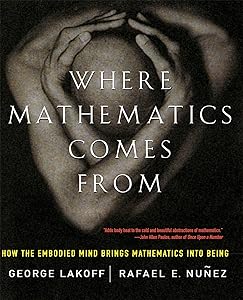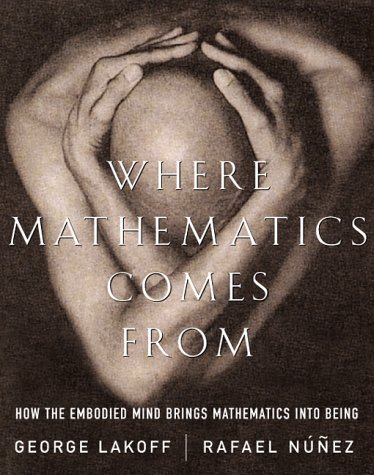
Where Mathematics Comes From: How The Embodied Mind Brings Mathematics Into Being by George Lakoff

Where Mathematics Comes From: How The Embodied Mind Brings Mathematics Into Being

George Lakoff
512 pages
Basic Books
Nov 2000
First Edition
History WSBN
2
Readers
0
Reviews
0
Discussions
0
Quotes
When you think about it, it seems obvious: The only mathematical ideas that human beings can have are ideas that the human brain allows. We know a lot about what human ideas are like from research in Cognitive Science. Most ideas are unconscious, and that is no less true of the mathematical ones. Abstract ideas, for the most part, arise via conceptual metaphor-a mechanism for projecting embodied (that is, sensory-motor) reasoning to abstract reasoning. This book argues that conceptual metaphor plays a central, defining role in mathematical ideas within the cognitive unconscious-from arithmetic and algebra to sets and logic to infinity in all of its forms: transfinite numbers, points at infinity, infinitesimals, and so on. Even the real numbers, the imaginary numbers, trigonometry, and calculus are based on metaphorical ideas coming out of the way we function in the everyday physical world.This book is about mathematical ideas, about what mathematics means-and why. The authors believe that understanding the metaphors implicit in mathematics will make mathematics make more sense. Moreover, understanding mathematical ideas and how they arise from our bodies and brains will make it clear that the brain's mathematics is mathematics, the only mathematics we know or can know.
Join the conversation

No discussions yet. Join BookLovers to start a discussion about this book!

No reviews yet. Join BookLovers to write the first review!

No quotes shared yet. Join BookLovers to share your favorite quotes!

Earn Points
Your voice matters. Every comment, review, and quote earns you reward points redeemable for Bitcoin.
Comment +5 pts Review +20 pts Quote +7 pts Upvote +1 pt
BookMatch Quiz
Find books similar to this one
About this book
Pages 512
Publisher Basic Books
Published 2000
Readers 2