No discussions yet. Join BookLovers to start a discussion about this book!
The Financial Crisis Moves From the Private Sector to the Public Sector.
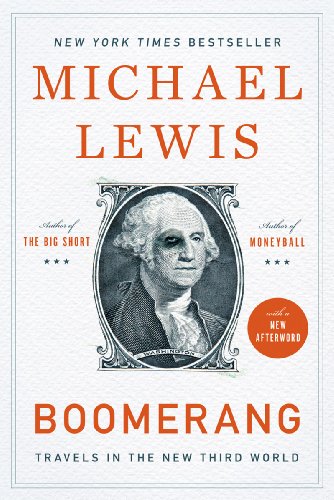
I admit to being a fan of Michael Lewis' books, so take that into consideration as you read this review. Lewis earned a masters degree in economics from the London School of Economics and went to work as a bond trader for Salomon Brothers before its scandals. His education and investment experience qualified him to write "Liar's Poker" in 1989, though I have no idea what qualified him to write such an entertaining and lucid description of the Wall Street culture of that time. Subsequently, I have read Lewis' "Moneyball" (in 2003), "The Blind Side" (in 2006), and "The Big Short" (in 2010). All of these books are very easy to read and hard to put down. They tell well-researched, interesting stories. In the case of "The Big Short" it helps to illuminate the origins of the financial crisis that broke starting in 2007. In Lewis' latest book, "Boomerang," the subtitle is, "Travels in the New Third World." Lewis is not referring to Asian or Latin American countries here. He's talking about European countries that drank the elixir of seemingly endless and cheap credit prior to the bursting of the recent financial bubble. To say that cheap credit transformed the economies in Greece, Ireland and Iceland, for example, is to understate the impact of the financial bubble on these countries. Talk about a timely book--I am writing this during September 2011, and yet this book refers to the recent downgrade of U.S. debt, which occured only last month, beginning on page 171. As in many of Lewis' books, there's a new person who you probably never heard of before to meet. In "Moneyball" it was Billy Beane, the general manager of the Oakland Athletics baseball team, and in "The Big Short" it was Steve Eisman, Michael Burry and others. This time it's Kyle Bass, the manager of a Dallas-based hedge fund, who Lewis makes sound both very insightful and eccentric. What would you call a man who owns a 40,000 square foot ranch located on thousands of acres in the middle of nowhere with its ...
No quotes shared yet. Join BookLovers to share your favorite quotes!
Earn Points
Your voice matters. Every comment, review, and quote earns you reward points redeemable for Bitcoin.