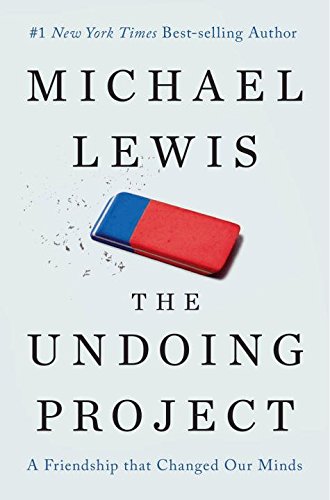
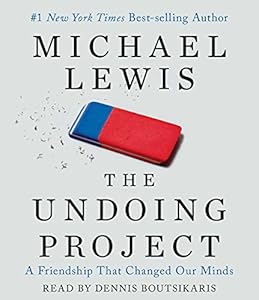
The Undoing Project: A Friendship that Changed Our Minds by Michael Lewis

The Undoing Project: A Friendship that Changed Our Minds

Michael Lewis
320 pages
W W Norton
Dec 2016
Business & Investing WSBN
4
Readers
1
Reviews
0
Discussions
0
Quotes
<p>Best-selling author Michael Lewis examines how a Nobel Prize-winning theory of the mind altered our perception of reality.</p><p>Forty years ago, Israeli psychologists Daniel Kahneman and Amos Tversky wrote a series of breathtakingly original studies undoing our assumptions about the decision-making process. Their papers showed the ways in which the human mind erred, systematically, when forced to make judgments about uncertain situations. Their work created the field of behavioral economics, revolutionized Big Data studies, advanced evidence-based medicine, led to a new approach to government regulation, and made much of Michael Lewis's own work possible. Kahneman and Tversky are more responsible than anybody for the powerful trend to mistrust human intuition and defer to algorithms.</p><p>The Undoing Project is about the fascinating collaboration between two men who have the dimensions of great literary figures. They became heroes in the university and on the battlefield -- both had important careers in the Israeli military -- and their research was deeply linked to their extraordinary life experiences. In the process they may well have changed, for good, mankind's view of its own mind.</p>

No discussions yet. Join BookLovers to start a discussion about this book!

Wonderful story about a friendship and about us

We understand a lot more about how we make decisions, the kinds of mistakes we seem to make and how we experience our world thanks to Danny and Amos, two grandsons of rabbis who lost their religion. These two men taught us that we are not natural statisticians and that our rules of thumb and gut feelings often lead us astray. They explained that we tell ourselves stories about people and things that are representative, that we make judgments based on insufficient data. For example, we often think that a handsome person is smarter. Or—take another example--have you ever decided that a three-year old is going to be a movie star or a doctor? How did you decide that this three-year old will find that profession appealing? Certainly not by using statistics. One of the first things Danny and Amos discovered is that even trained statisticians are not natural statisticians. We all make decisions based not on probability but on stories. And there is more. It turns out we are very, very risk averse. We will do a lot to avoid feeling (or remembering the feel of) pain. Indeed, we are “happy” to experience (on the whole) more pain in order to remember less pain. And we will risk a lot to avoid losing things that we own or think we own. And by think we own, I mean we have an ingrained sense of what we are entitled to. There is a famous case study of monkeys who are all perfectly happy eating cucumbers so long as they all get cucumbers. But the minute some of them got bananas and some got cucumbers the monkeys who got cucumbers threw their cucumbers away in fury. They had no interest in being treated unequally. Humans are the same way. If you treat people equally, we’re OK with that; if you obviously advantage some people over some others, we get mad. Really mad. We know all this thanks to two Israeli psychologists. When we make decisions when very little is or can be known, things are even worse. Then we use shortcuts called framing (the stories we tell to explain an event tha...

No quotes shared yet. Join BookLovers to share your favorite quotes!