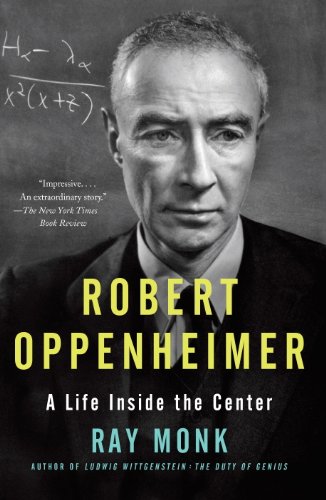

Robert Oppenheimer: A Life Inside the Center by Ray Monk

Robert Oppenheimer: A Life Inside the Center

Ray Monk
Doubleday
May 2013
History WSBN
2
Readers
1
Reviews
0
Discussions
0
Quotes
An exploration of the enigma of Robert Oppenheimer's life and personality and his contributions to the revolution in twentieth-century physics.
Join the conversation

No discussions yet. Join BookLovers to start a discussion about this book!

Covers the academic side very well

Monk's biography covers all that Bird and and Sherwin left out: the development and course of Oppenheimer's academic life. Monk followed Rabi's suggestion that Oppenheimer had a vacuum because he ignored his Jewishness, which is interesting as well but the coverage of academic development is first rate. The book is a history of the development of physics 1920-50 and of American nuclear science policy in the early 1950s. Monk covers very well the story of how Truman and Eisenhower rejected the proposal to try to reach a nuclear policy agreement with the USSR, and instead went ahead full steam with the USAF's drive to get the H-bomb. I.e., how we ended up in the situation where Dr. Strangelove's policy won. I have a small correction to add. On pg. 410 Monk follows the standard line that Heisenberg did not know how to calculate critical radii. This claim was laid to rest in my American Journal of Physics paper AJP 92, 765-74, 2024. Heisenberg foreshadowed Serber's Los Alamos Primer by formulating the critical radius problem and calculating radii for reactors in 1939. Under captivity at Farm Hall in 1945 he recalled his 1939 work from memory and independently reproduced Serber's 1943 calculation for a bomb. He only knew the fast fission cross sections between two limits. Serber's cross section was midway between the two. It is ludicrous to continue to repeat Goudsmit's misconception that Heisenberg did not understand the difference between a reactor and a bomb. Mathematically, there is no difference in the basic formula for the critical radius, the difference is in the cross sections and neutron production per fission that enter the formula. Otherwise Monk's book is extremely interesting and well worth reading. After reading Bird and Sherwin, in contrast, I had trouble recalling what I'd read chapter by chapter. Read more

No quotes shared yet. Join BookLovers to share your favorite quotes!

Earn Points
Your voice matters. Every comment, review, and quote earns you reward points redeemable for Bitcoin.
Comment +5 pts Review +20 pts Quote +7 pts Upvote +1 pt
BookMatch Quiz
Find books similar to this one
About this book
Publisher Doubleday
Published 2013
Readers 2