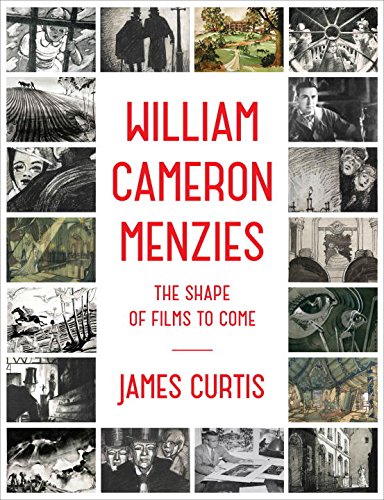
William Cameron Menzies: The Shape of Films to Come
James Curtis
He was the consummate designer of film architecture on a grand scale, influenced by German expressionism and the work of the great European directors. He was known for his visual flair and timeless innovation, a man who meticulously preplanned the color and design of each film through a series of continuity sketches that made clear camera angles, lighting, and the actors' positions for each scene, translating dramatic conventions of the stage to the new capabilities of film. <br> Here is the long-awaited book on William Cameron Menzies, Hollywood's first and greatest production designer, a job title David O. Selznick invented for Menzies' extraordinary, all-encompassing, Academy Award-winning work on <i>Gone With the Wind</i> (which he effectively co-directed) . <br><br> It was Menzies - winner of the first-ever Academy Award for Art Direction, jointly for <i>The Dove </i>(1927) and <i>Tempest</i> (1928) , and who was as well a director (fourteen pictures) and a producer (twelve pictures) - who changed the way movies were (and still are) made, in a career that spanned four decades, from the 1920s through the 1950s. His more than 120 films include <i>Rosita</i> (1923) , <i>Things to Come</i> (1936) , <i>Foreign Correspondent</i> (1940) , <i>Kings Row </i>(1942) ,<i> Mr. Lucky</i> (1943) , <i>The Pride of the Yankees </i>(1943) , <i>For Whom the Bell Tolls</i> (1943) , <i>Address Unknown</i> (1944) ,<i> It's a Wonderful Life</i> (1947) , <i>Invaders from Mars</i> (1953) , and <i>Around the World in 80 Days </i>(1956) .<br><br> Now, James Curtis, acclaimed film historian and biographer, writes of Menzies' life and work as the most influential designer in the history of film. His artistry encompassed the large, scenic drawings of Douglas Fairbanks' <i>The Thief of Bagdad</i> (1924) , which created a new standard for beauty on the screen and whose exotic fairy-tale sets are still regarded as pure genius. ("I saw <i>The Thief of Bagdad</i> when it first came out," said Orson Welles - he was, at the time, a nine-year-old boy. "I'll never forget it.") Curtis writes of Menzies' design and supervision of John Barrymore's<i> Beloved Rogue</i> (1927) , a film that remains a masterpiece of craft and synthesis, one of the most distinctive pictures to emerge from Hollywood's waning days of silent films, and of his extraordinary, opulent appointments for <i>Gone With the Wind</i> (1939) .<br><br> It was Menzies who defined and solidified the role of art director as having overall control of the look of the motion picture, collaborating with producers like David O. Selznick and Samuel Goldwyn; with directors such as D. W. Griffith, Raoul Walsh, Alfred Hitchcock, Lewis Milestone, and Frank Capra. And with actors as varied as Ingrid Bergman, W. C. Fields, Cary Grant, Clark Gable, John Barrymore, Barbara Stanwyck, Ronald Reagan, Gary Cooper, Vivien Leigh, Carole Lombard, Mary Pickford, Gloria Swanson, and David Niven. <br><br> Interviewing colleagues, actors, directors, friends, and family, and with full access to the William Cameron Menzies family collection of original artwork, correspondence, scrapbooks, and unpublished writing, Curtis brilliantly gives us the path-finding work of the movies' most daring and dynamic production designer: his evolution as artist, art director, production designer, and director. Here is a portrait of a man in his time that makes clear how the movies were forever transformed by his startling, visionary work.<br><br><i>(With 16 pages of color illustrations, and black-and-white photographs throughout.) </i>