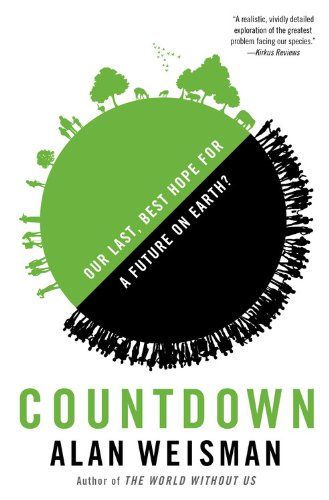
Countdown: Our Last, Best Hope for a Future on Earth? by Alan Weisman

Countdown: Our Last, Best Hope for a Future on Earth?

Alan Weisman
512 pages
Back Bay Books / Little
May 2014
Hardcover
Outdoors & Nature WSBN
4
Readers
1
Reviews
0
Discussions
0
Quotes
A powerful investigation into the chances for humanity's future from the author of the bestseller The World Without Us.<br><br>In his bestselling book The World Without Us, Alan Weisman considered how the Earth could heal and even refill empty niches if relieved of humanity's constant pressures. Behind that groundbreaking thought experiment was his hope that we would be inspired to find a way to add humans back to this vision of a restored, healthy planet-only in harmony, not mortal combat, with the rest of nature.<br><br>But with a million more of us every 4 1/2 days on a planet that's not getting any bigger, and with our exhaust overheating the atmosphere and altering the chemistry of the oceans, prospects for a sustainable human future seem ever more in doubt. For this long awaited follow-up book, Weisman traveled to more than 20 countries to ask what experts agreed were probably the most important questions on Earth--and also the hardest: How many humans can the planet hold without capsizing? How robust must the Earth's ecosystem be to assure our continued existence? Can we know which other species are essential to our survival? And, how might we actually arrive at a stable, optimum population, and design an economy to allow genuine prosperity without endless growth?<br><br>Weisman visits an extraordinary range of the world's cultures, religions, nationalities, tribes, and political systems to learn what in their beliefs, histories, liturgies, or current circumstances might suggest that sometimes it's in their own best interest to limit their growth. The result is a landmark work of reporting: devastating, urgent, and, ultimately, deeply hopeful.<br><br>By vividly detailing the burgeoning effects of our cumulative presence, Countdown reveals what may be the fastest, most acceptable, practical, and affordable way of returning our planet and our presence on it to balance. Weisman again shows that he is one of the most provocative journalists at work today, with a book whose message is so compelling that it will change how we see our lives and our destiny.
Join the conversation

No discussions yet. Join BookLovers to start a discussion about this book!

A very significant book on population

This has to be the most significant book on population in decades. Why? Because Alan Weisman, author of bestseller The World Without Us, travelled the world over three years to 21 countries and interviewed not only demographers, park rangers, health workers, ornithologists, doctors, resource managers, agricultural scientists, reproductive rights advocates, journalists, farmers, theologians, politicians, geographers, hydrologists, environmental activists, bio-geochemists and conservation biologists, but young mothers from the huts of Niger to an apartment tower in Tokyo. It’s worth considering the countries he visited because it illustrates how extensive were his travels. They were Israel, Palestine, Jordan, United Kingdom, Costa Rica, Puerto Rica, Uganda, China, Philippines, Mexico, the Vatican, Italy, Niger, Libya, Pakistan, Nepal, India, Japan, Thailand, Iran and his own country, the United States. This book about population goes far beyond simple demographics. It addresses how many people various countries can sustain without destroying the environment, and in light of looming problems such as climate change, peak oil, water shortages and general resource scarcity. He has concluded well before the end of the book: ‘The Earth can’t sustain our current numbers – and inevitably, one way or another, those numbers must come down.’ The truly classic photo on the title page A little bit crowded transport by Roberto Neumiller is worth more than a thousand words; it is the quintessential metaphor for an overloaded planet. Thanks to translators, Weisman was able to interview many people who do not normally appear on the world stage. At times I was shaken by what they had to say. In Niger, for instance, the country with the highest fertility rate in the world (7.0), the 70 year old village chief of Bargaja has to count his beads before he can remember how many children he has. ‘Seventeen,’ he says eventually. ‘Seventeen who are still alive. I’ve lost at least that many.’...

No quotes shared yet. Join BookLovers to share your favorite quotes!

Earn Points
Your voice matters. Every comment, review, and quote earns you reward points redeemable for Bitcoin.
Comment +5 pts Review +20 pts Quote +7 pts Upvote +1 pt
BookMatch Quiz
Find books similar to this one
About this book
Pages 512
Publisher Back Bay Books / Lit...
Published 2014
Readers 4