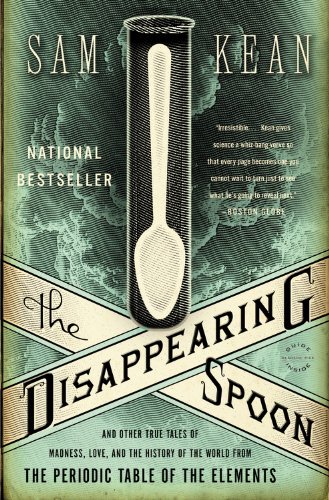
The Disappearing Spoon: And Other True Tales of Madness, Love, and the History of the World from the Periodic Table of the Elements by Sam Kean

The Disappearing Spoon: And Other True Tales of Madness, Love, and the History of the World from the Periodic Table of the Elements

Sam Kean
Back Bay Books; Reprint edition
Jun 2011
WSBN
4
Readers
1
Reviews
0
Discussions
0
Quotes
From New York Times bestselling author Sam Kean comes incredible stories of science, history, finance, mythology, the arts, medicine, and more, as told by the Periodic Table. Why did Gandhi hate iodine (I, 53)? How did radium (Ra, 88) nearly ruin Marie Curie's reputation? And why is gallium (Ga, 31) the go-to element for laboratory pranksters?*The Periodic Table is a crowning scientific achievement, but it's also a treasure trove of adventure, betrayal, and obsession. These fascinating tales follow every element on the table as they play out their parts in human history, and in the lives of the (frequently) mad scientists who discovered them. THE DISAPPEARING SPOON masterfully fuses science with the classic lore of invention, investigation, and discovery--from the Big Bang through the end of time.
Join the conversation

No discussions yet. Join BookLovers to start a discussion about this book!

Loved it

I am an engineer, and have spent a good chunk of my life dealing with parts of the periodic table. I bought this book on an impulse, and I am glad I did. It was a very enjoyable experience reading it, and I was sorry when it came to an end. === The Good Stuff === * Sam Kean does a great job in mixing a litte science, a touch of history, some genuine supposition and a dash of humor. The result is a view of the periodic table, its history, and a number of stories about some of its residents. He writes in a fun, easy to read style, and doesn't include a lot of technical jargon or fifteen letter words. * Kean is mostly careful about what is proven knowledge versus what is informed supposition, although he occasionally gets careless with what is fact versus hearsay. Still, most of the "how this was discovered" stories are more for entertainment value, this is a perfectly acceptable standard. * While this is in no way a chemistry or physics book, to understand the beauty, logic, and difficulty in constructing the periodic table, you need to know some details about the structure of an atom. Kean strikes a nice balance. The text is technical enough to highlight what makes the periodic table so clever and useful, but yet perfectly understandable by anyone with even the slightest hint of how an atom is constructed. * Kean has a gift of tying history, myth, science and intelligent guesswork together. As an example, he relates a tale of an area of Asia Minor, where copper, zinc and tin ores exist, often mingled together. Copper and tin, mixed together make bronze, a dull, yellowy metal. But copper and zinc mixed together make brass, a very shiny golden metal, which can plausibly be mistaken for gold by ancient alchemists. And Asia Minor is noted for having some very early bronze foundries, and coincidentally, the legendary home of King Midas. Kean can't prove that some ancient process for replacing the tin in bronze with zinc, and thereby making brass, was mistaken for alche...

No quotes shared yet. Join BookLovers to share your favorite quotes!

Earn Points
Your voice matters. Every comment, review, and quote earns you reward points redeemable for Bitcoin.
Comment +5 pts Review +20 pts Quote +7 pts Upvote +1 pt
BookMatch Quiz
Find books similar to this one
About this book
Publisher Back Bay Books; Repr...
Published 2011
Readers 4