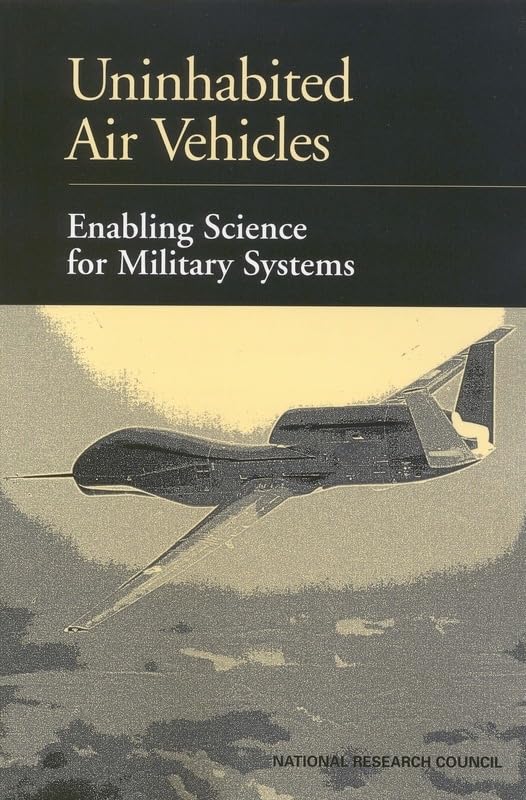
Uninhabited Air Vehicles: Enabling Science for Military Systems (Compass Series) by National Research Council

Uninhabited Air Vehicles: Enabling Science for Military Systems (Compass Series)

National Research Council
124 pages
National Academies Press
Jul 2000
Paperback
Professional & Technical WSBN
0
Readers
0
Reviews
0
Discussions
0
Quotes
U.S. Air Force (USAF) planners have envisioned that uninhabited air vehicles (UAVs) , working in concert with inhabited vehicles, will become an integral part of the future force structure. Current plans are based on the premise that UAVs have the potential to augment, or even replace, inhabited aircraft in a variety of missions. However, UAV technologies must be better understood before they will be accepted as an alternative to inhabited aircraft on the battlefield. The U.S. Air Force Office of Scientific Research (AFOSR) requested that the National Research Council, through the National Materials Advisory Board and the Aeronautics and Space Engineering Board, identify long-term research opportunities for supporting the development of technologies for UAVs. The objectives of the study were to identify technological developments that would improve the performance and reliability of "generation-after-next" UAVs at lower cost and to recommend areas of fundamental research in materials, structures, and aeronautical technologies. The study focused on innovations in technology that would "leapfrog" current technology development and would be ready for scaling-up in the post-2010 time frame (i.e., ready for use on aircraft by 2025) .
Join the conversation

No discussions yet. Join BookLovers to start a discussion about this book!

No reviews yet. Join BookLovers to write the first review!

No quotes shared yet. Join BookLovers to share your favorite quotes!

Earn Points
Your voice matters. Every comment, review, and quote earns you reward points redeemable for Bitcoin.
Comment +5 pts Review +20 pts Quote +7 pts Upvote +1 pt
BookMatch Quiz
Find books similar to this one
About this book
Pages 124
Publisher National Academies P...
Published 2000
Readers 0