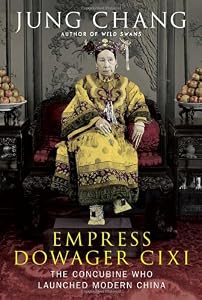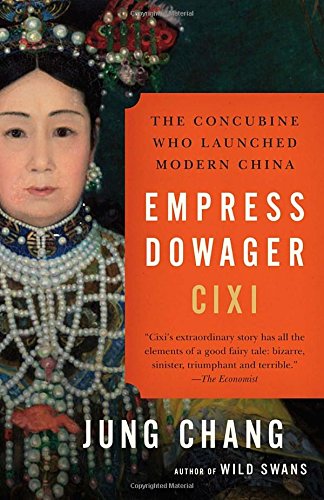
Empress Dowager Cixi: The Concubine Who Launched Modern China by Jung Chang
Empress Dowager Cixi: The Concubine Who Launched Modern China

Jung Chang
436 pages
Alfred A. Knopf
Sep 2014
Biographies & Memoirs WSBN
4
Readers
1
Reviews
0
Discussions
0
Quotes

Free account. We’ll keep this book ready while you join.

Find a copy

Formats and availability vary by store. As an Amazon Associate I earn from qualifying purchases.

<p><b>A <i>New York Times</i> Notable Book</b><br><b>An NPR Best Book of the Year</b><br><br> In 1852, at age sixteen, Cixi was chosen as one of Emperor Xianfeng's numerous concubines. When he died in 1861, their five-year-old son succeeded to the throne. Cixi at once launched a coup against her son's regents and placed herself as the true source of power - governing through a silk screen that separated her from her male officials.<br> Drawing on newly available sources, Jung Chang comprehensively overturns Cixi's reputation as a conservative despot. Cixi's extraordinary reign saw the birth of modern China. Under her, the ancient country attained industries, railways, electricity, and a military with up-to-date weaponry. She abolished foot-binding, inaugurated women's liberation, and embarked on a path to introduce voting rights. Packed with drama, this groundbreaking biography powerfully reforms our view of a crucial period in China's - and the world's - history. </p>
Join the conversation

No discussions yet. Join BookLovers to start a discussion about this book!

A brilliant ground-breaking biography of the most unfairly slandered person in Chinese history.

For over a century, Dowager Empress Cixi has been portrayed by conventional historians as a hidebound reactionary who usurped the throne of China to stultify China's progress and doomed the dynasty with her corruption and obtuseness. Jung Chang has deftly turned the slander on its head and written what is destined to be the definitive biography of one of the most wrongfully maligned persons in history, using massive primary documentation, most of it never before accessed by a historian. Among the debunked lies: (1) Although she did use some of the interest income from the naval fund to rebuild the Summer Palace, a decision she later deeply regretted, she did not bankrupt the navy. (2) She did not depose her adopted son, Emperor Guangxu, to thwart progress. Most of the reforms of the "100 Days" were her own ideas. The Emperor was suborned by Youwei Kang, an egotistical traitor who swayed the weak-willed Emperor with base flattery, to plot Cixi's assassination towards the end of turning his own empire over to Japan. (3) Against her better judgment, she did give reluctant support to the Boxers in the face of outrageous provocations by European powers, especially Germany, against Chinese sovereignty and abuses of the Chinese people. (4) She admired westerners and battled against her own councilors to modernize China. Her final major act was to approve a draft Constitution with an elected Parliament which was never realized. She was restrained by the innate conservatism of the country, the xenophobia of the people surrounding the throne and traditional restrictions on the role of women. Jung Chang illustrates this with brilliant descriptions of the pomp and pageantry of the imperial court contrasted with the squalor and ignorance that characterized most of the country. Some critics have said this book verges on hagiography, but the author carefully documents and substantiates every point she makes, and is also ready to point out Cixi's faults and errors. This is a bre...

No quotes shared yet. Join BookLovers to share your favorite quotes!

Earn Points
Your voice matters. Every comment, review, and quote earns you reward points redeemable for Bitcoin.
Comment +5 pts Review +20 pts Quote +7 pts Upvote +1 pt
Similar Books
Find books similar to this one
About this book
Pages 436
Publisher Alfred A. Knopf
Published 2014
Readers 4