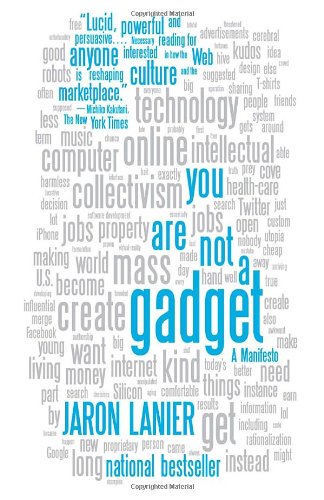


You Are Not a Gadget: A Manifesto by Jaron Lanier

You Are Not a Gadget: A Manifesto

Jaron Lanier
223 pages
Random House
Feb 2011
Computers & Internet WSBN
3
Readers
1
Reviews
0
Discussions
0
Quotes
<p><b>A NATIONAL BESTSELLER</b><br><br>A programmer, musician, and father of virtual reality technology, Jaron Lanier was a pioneer in digital media, and among the first to predict the revolutionary changes it would bring to our commerce and culture. Now, with the Web influencing virtually every aspect of our lives, he offers this provocative critique of how digital design is shaping society, for better and for worse.<br> <br>Informed by Lanier's experience and expertise as a computer scientist, <i>You Are Not a Gadget</i> discusses the technical and cultural problems that have unwittingly risen from programming choices - such as the nature of user identity - that were &quot;locked-in&quot; at the birth of digital media and considers what a future based on current design philosophies will bring. With the proliferation of social networks, cloud-based data storage systems, and Web 2.0 designs that elevate the &quot;wisdom&quot; of mobs and computer algorithms over the intelligence and wisdom of individuals, his message has never been more urgent.</p>
Join the conversation

No discussions yet. Join BookLovers to start a discussion about this book!

Thought provoking and thoughtful - a rare gem

If you interact with a computer and the computer doesn't know that you are not another machine, have you lost an essential part of your humanness? This unsettling book explores some of the strange conundra created by our fascination with all things `web 2.0'. From the way one programmer's convenience becomes the next generation's strait-jacket, to the loss of identity in wiki-based knowledge, and the lowering of self-esteem among Facebook addicted youth, to the `ideal' of perpetual existence as a stream of electrons in a computer's `consciousness, this book takes science fiction and roots it deep into the rich manure of common current `culture'. The concept that structure and process can speed up adoption and dissemination of new ideas by lowering volatility and improving message targeting is anathema to the proponents of wiki-style freedom. But is the freedom of information necessarily worth the sacrifice of individual expression, attribution and control? Proponents of the hive mind or noosphere would argue that case but Lanier takes an independent stance that values contribution of individuals as individuals, with their personal intelligence, experience and emotion, above the anonymous, often re-edited and variable outputs of agglomerated information mash-ups. It is a brave, but valid, stance and coherently reasoned. The doctrine of crowd-based wisdom is infiltrating strategy and policy development processes. Whilst involvement is inherently useful, it appears obvious, upon reading this treatise, that there should be clear limits to the way in which crowds are used and scope for individual attributable contributions to retain relevance. The use of pseudonyms and anonymous postings is definitely supporting the rise of `Trolls'. Trolls, in cyberspace, are people who are abusive towards other people or ideas. They have been implicated in cyber-bullying which leaves boards exposed to claims of failure to prevent harassment and/or discrimination. The move towards tr...

No quotes shared yet. Join BookLovers to share your favorite quotes!

Earn Points
Your voice matters. Every comment, review, and quote earns you reward points redeemable for Bitcoin.
Comment +5 pts Review +20 pts Quote +7 pts Upvote +1 pt
BookMatch Quiz
Find books similar to this one
About this book
Pages 223
Publisher Random House
Published 2011
Readers 3