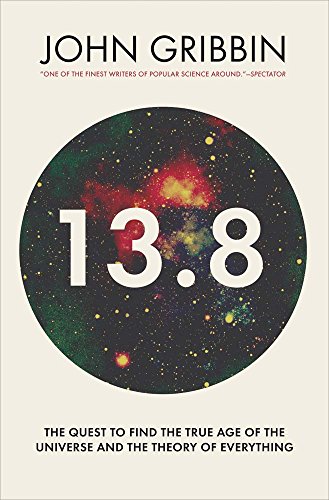
13.8: The Quest to Find the True Age of the Universe and the Theory of Everything by John Gribbin

13.8: The Quest to Find the True Age of the Universe and the Theory of Everything

John Gribbin
256 pages
Yale University Press
Mar 2016
Science WSBN
3
Readers
1
Reviews
0
Discussions
0
Quotes
The twentieth century gave us two great theories of physics. The general theory of relativity describes the behavior of very large things, and quantum theory the behavior of very small things. In this landmark book, John Gribbin - one of the best-known science writers of the past thirty years - presents his own version of the Holy Grail of physics, the search that has been going on for decades to find a unified "Theory of Everything" that combines these ideas into one mathematical package, a single equation that could be printed on a T-shirt, containing the answer to life, the Universe, and everything. With his inimitable mixture of science, history, and biography, Gribbin shows how - despite skepticism among many physicists - these two great theories are very compatible, and point to a deep truth about the nature of our existence. The answer lies, intriguingly, with the age of the universe: 13.8 billion years.
Join the conversation

No discussions yet. Join BookLovers to start a discussion about this book!

One of the two or three best science books I have ever read

13.8 billion years (± .021 billion years): That is the age of the Universe. In this book John Gribbin tells how that figure was determined -- with the most recent input coming in 2015. He also tells how it was determined that the oldest stars in our Galaxy (the Milky Way) are a bit more than 13 billion years old. He concludes that "the discovery that the ages of the oldest stars and the age of the Universe are almost the same, with the stars (crucially) being slightly younger than the Universe in which they live is * * * one of the most profound discoveries ever made." Moreover, it "powerfully suggests that both the general theory of relativity and quantum mechanics are correct in some fundamental way, and might one day be unified." For me, reading 13.8 was immensely educational as well as exhilarating. I am not a scientist and my once decent facility in mathematics long ago withered away from disuse. Over the past three decades I have occasionally tried to read, and learn, about quantum mechanics and the more recent cosmological theories, but the books or articles I consulted overwhelmed and defied me. Not so with Gribbin's 13.8. It is exceptionally well and lucidly written for a work of hard-core science. (Gribbin is an astrophysicist and a long-time Visiting Fellow in Astronomy at the University of Sussex; he studied or worked with several of the scientists mentioned in the book, and he participated in several of the studies or projects contributing to its conclusions; he also is reputed to be one of the finest science writers active today.) Gribbin begins his story with the discovery, in 1965, of cosmic microwave background radiation, with a temperature of 2.712 K. "The essential point is that this radiation * * * tells us that the Universe as we know it had a definite beginning a finite time ago." The question then becomes, how long ago? Before addressing that, Gribbin, in Part One, recounts the story of determining, first, the age of the Earth, Sun, and Sol...

No quotes shared yet. Join BookLovers to share your favorite quotes!

Earn Points
Your voice matters. Every comment, review, and quote earns you reward points redeemable for Bitcoin.
Comment +5 pts Review +20 pts Quote +7 pts Upvote +1 pt
BookMatch Quiz
Find books similar to this one
About this book
Pages 256
Publisher Yale University Pres...
Published 2016
Readers 3