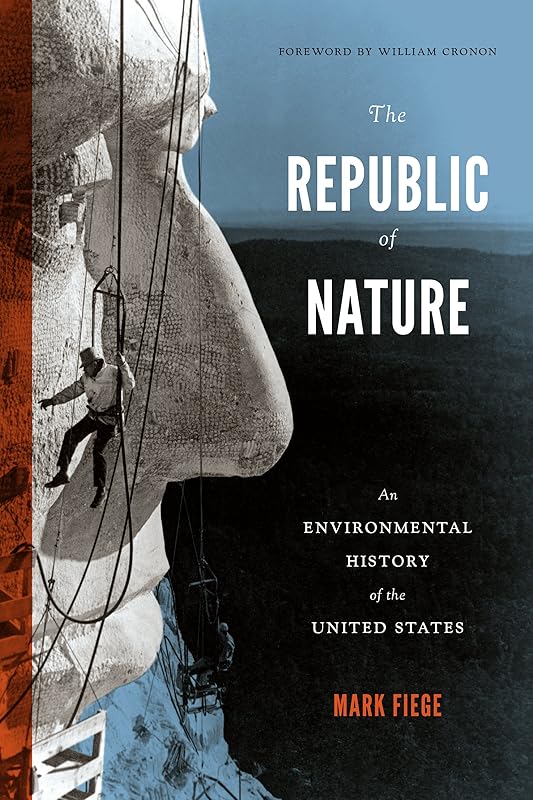
In the dramatic narratives that comprise The Republic of Nature, Mark Fiege reframes the canonical account of American history based on the simple but radical premise that nothing in the nation's past can be considered apart from the natural circumstances in which it occurred. Revisiting historical icons so familiar that schoolchildren learn to take them for granted, he makes surprising connections that enable readers to see old stories in a new light.
Among the historical moments revisited here, a revolutionary nation arises from its environment and struggles to reconcile the diversity of its people with the claim that nature is the source of liberty. Abraham Lincoln, an unlettered citizen from the countryside, steers the Union through a moment of extreme peril, guided by his clear-eyed vision of nature's capacity for improvement. In Topeka, Kansas, transformations of land and life prompt a lawsuit that culminates in the momentous civil rights case of Brown v. Board of Education.
By focusing on materials and processes intrinsic to all things and by highlighting the nature of the United States, Fiege recovers the forgotten and overlooked ground on which so much history has unfolded. In these pages, the nation's birth and development, pain and sorrow, ideals and enduring promise come to life as never before, making a once-familiar past seem new. The Republic of Nature points to a startlingly different version of history that calls on readers to reconnect with fundamental forces that shaped the American experience.
For more information, visit the author's website: http://republicofnature.com/
Read more Continue reading Read less REVIEW
"Fiege has written a book that will undoubtedly leave an imprint on the field of environmental history and beyond. . . . he has added his book to a short list of must-reads in the field of environmental history." -- David Arnold, Pacific Northwest Quarterly, Win. 2011/2012
"Fiege makes a powerful case for always asking the question 'How does nature matter?' when thinking about any present or historical issue or social policy." -- Tikkun, Summer 2012
"This smart and well-written book, one both synthetic and generative, hopefully will, in fact, prompt students, researchers, and the public to further explore the 'paths that circle through the nature of American history . . .'." -- Brett Mitzelle, Southern California Quarterly, Summer 2013
"The Republic of Nature is an incredibly ambitious and completely unprecedented book Fiege's goal is no less than to demonstrate the centrality of the nonhuman world to any understanding of the American past. The intended audience is wide, and this book invites the broadest consideration and debate." -- Linda Nash, Isis 104, September 2013
"Mark Fiege re-frames the canonical account of American history based on the simple but radical premise that nothing in the nation's past can be considered apart from the natural circumstances in which it occurredand points to a different version of history that prompts us to reconnect with fundamental forces that shaped the American experience." -- Tom Williams, Utah Public Radio, September 27 2013
"The Republic of Nature dares us to think differently in the way the best history books do -- by thoroughly engaging readers in unexpected ways and in challenging our perceptions of the ways the world works." -- Raechel Lutz, Pennsylvania Magazine of History and Biography, April 2013
"Readers will be surprised and delighted by how much Fiege accomplishes in each case study. . . . a fine and affordable supplement to U.S. history surveys . . . [and] American environmental history courses." -- Paul W. Hirt, Oregon Historical Quarterly, Spring 2013
"Fiege's book is extraordinary: beautifully written, ambitious in its arguments, and impressive in scope and scholarship. . . a compelling and ambitious study of American history that will enrich the classroom and provoke new scholarship." -- James Morton Turner, Journal of American History, December 2012
"Fiege is a fine storyteller with a powerful sense of historical context, and popular readers will like that this book is environmental history served up in a rich mixture of information they'll find familiar and grounding." -- Montana: The Magazine of Western History, Winter 2012
"This imaginative and well-researched . . . approach should prompt scholars to continue to reexamine US history through an environmental prism. Recommended." -- Choice, January 2013
"Fiege is a good storyteller; he is knowledgeable; he writes well; and he keeps it simple." -- Robert Pogue Harrison, New York Review of Books, October 25 2012
"The Republic of Nature compellingly demonstrates the value of applying environmental perspective to historical events. From this we can learn the value of applying environmental perspectives to the history we are creating today." -- Robert E. Hoopes, Wildlife Activist, Summer 2012
"The writing is compelling and will reward general readers as well as environmental historians with a new way of thinking about history." -- Minnesota History, Summer 2012
"Fiege's fresh new spin on important historical events of U.S. history places social and political factors on the background to highlight the environmental context. This thought-provoking book tells a different version of American history than the one we are used to, where nature plays a fundamental role in the events that shaped the nation." -- Institute for Global Environmental Strategies
"Mark Fiege's book presents a concept that is as revolutionary as it is obvious, writing history as if the natural world mattered. . . . Fiege takes a look at historical events so well-worn they've become platitudes and makes them fresh again . . . by . . . examining them through an environmental lens . . ." -- Christian Martin, Cascadia Weekly,