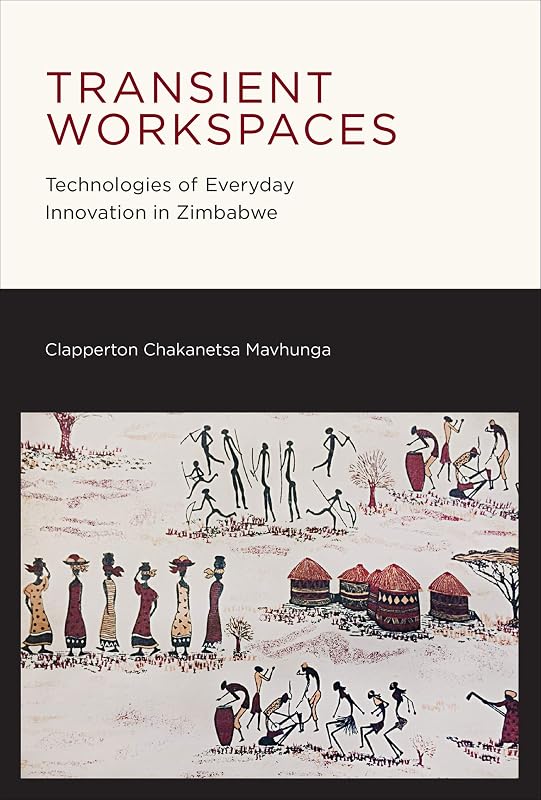
Transient Workspaces: Technologies of Everyday Innovation in Zimbabwe
Clapperton Chakanets Mavhunga
An account of technology in Africa from an African perspective, examining hunting in Zimbabwe as an example of an innovative mobile workspace.In this book, Clapperton Mavhunga views technology in Africa from an African perspective. Technology in his account is not something always brought in from outside, but is also something that ordinary people understand, make, and practice through their everyday innovations or creativities - including things that few would even consider technological. Technology does not always originate in the laboratory in a Western-style building but also in the society in the forest, in the crop field, and in other places where knowledge is made and turned into practical outcomes.
African creativities are found in African mobilities. Mavhunga shows the movement of people as not merely conveyances across space but transient workspaces. Taking indigenous hunting in Zimbabwe as one example, he explores African philosophies of mobilities as spiritually guided and of the forest as a sacred space. Viewing the hunt as guided mobility, Mavhunga considers interesting questions of what constitutes technology under regimes of spirituality. He describes how African hunters extended their knowledge traditions to domesticate the gun, how European colonizers, with no remedy of their own, turned to indigenous hunters for help in combating the deadly tsetse fly, and examines how wildlife conservation regimes have criminalized African hunting rather than enlisting hunters (and their knowledge) as allies in wildlife sustainability. The hunt, Mavhunga writes, is one of many criminalized knowledges and practices to which African people turn in times of economic or political crisis. He argues that these practices need to be decriminalized and examined as technologies of everyday innovation with a view toward constructive engagement, innovating with Africans rather than for them.
Read more Continue reading Read less REVIEW
Adroitly blending the traditional and the modern, this refreshing history of Zimbabwe offers an original interpretation of African technology. Using an environmental motif, Mavhunga's novel approach is an important contribution, highlighting the agency of ordinary people, their mobility, their ingenuity, and their knowledge both of humanity and the natural and spiritual environment.
-- Jane Carruthers, Emeritus Professor, University of South Africa; author of The Kruger National Park: A Social and Political History --This text refers to the paperback edition. ABOUT THE AUTHOR
Clapperton Chakanetsa Mavhunga is Associate Professor of Science, Technology, and Society at MIT. He is the author of Transient Workspaces: Technologies of Everyday Innovation in Zimbabwe and the editor of What Do Science, Technology, and Innovation Mean from Africa?, both published by the MIT Press. --This text refers to the paperback edition. REVIEW
Mavhunga expertly applies African-based theoretical innovations to extend the new mobilities paradigm and histories of technology and, in doing so, to generate new ways of thinking about mobility--far beyond the sociotechnological novelties that animate the West. Drawing on his deeply experiential understanding of the material, philosophical, and spiritual bases of the hunting practices of the vaShona and maTshangana people, he shows how they created pathways and ways of working together that he calls 'transient workspaces.' In a gracefully executed pivot, he uses this understanding to challenge Western understandings of mobility, technology, wildlife conservation, and biodiversity management.
(Mimi Sheller, Director of the Center for Mobilities Research and Policy, Drexel University; author of Aluminum Dreams: The Making of Light Modernity)
Clapperton Mavhunga's study is important for weaving together concepts from mobility studies, environmental history, studies in the diffusion of technology (in this case firearms) , colonial and post-colonial studies of Africa, and the history of technology to understand the past two centuries of life in what is today Zimbabwe. His accounts joins many others that have shown why Western technologies often cannot be successfully introduced from the outside. Rarely, however, have the results of ignoring local residents during the transfer process been sketched in such stark and forceful terms. Mavhunga's account upends traditional understandings of everything from African independence movements to poaching to what we think we know about technological innovation.
(Bruce E. Seely, Dean, College of Sciences and Arts, Michigan Technological University)
This fascinating narrative describes how vaShona and maTshangana hunters exercised significant 'bottom-up' control over colonizers' efforts to eradicate the tsetse fly in southern Africa. The author masterfully blends archival interviews and colonial records to show how indigenous culture shaped the use of European weapons in ways that illumine current efforts to control wild animal poaching in the region.
(Donald E. Klingner, Distinguished Professor, University of Colorado Colorado Springs)
Adroitly blending the traditional and the modern, this refreshing history of Zimbabwe offers an original interpretation of African technology. Using an environmental motif, Mavhunga's novel approach is an important contribution, highlighting the agency of ordinary people, their mobility, their ingenuity, and their knowledge both of humanity and the natural and spiritual environment.
(Jane Carruthers, Emeritus Professor, University of South Africa; author of The Kruger National Park: A Social and Political History) --This text refers to the unknownbinding edition. Read more Continue reading Read less